

UK ISA US Resident Compliance Checker
Calculate Your Reporting Requirements
Enter your current financial details to see if you trigger IRS reporting thresholds and estimate the annual tax impact of holding a UK ISA.
Form 8938 Requirement
Threshold: $50k (year-end) or $75k (any time).
Contribution Status
Cannot contribute as non-UK resident.
Phantom Income Tax Liability (Estimate)
The IRS taxes the deemed distribution (growth) annually, even if not withdrawn.
*This is an estimate based on provided growth rate and tax bracket. Actual liability depends on specific asset types within the ISA.
You moved to New York for a job, or maybe you landed in Texas for family. You still have that old Individual Savings Account, also known as an ISA, which is a UK government-approved wrapper that allows tax-free growth on investments and savings. It was your safety net back home. Now, looking at your bank statements from across the Atlantic, you’re wondering: Can I keep it? Can I add money to it? And more importantly, will the IRS come knocking?
The short answer is yes, but with a massive asterisk. You can hold the account, but you likely cannot contribute to it anymore. More critically, keeping that account open might trigger a headache called Form 8938, which could lead to penalties if you aren’t careful. This isn’t just about losing tax benefits; it’s about navigating two very different tax systems that don’t always play nice together.
Residency Is Everything: The HMRC Test
To understand what happens to your ISA, you first need to understand how the UK defines "you." The UK tax authority, HM Revenue and Customs, commonly referred to as HMRC, which is the British government department responsible for collecting taxes and paying out some state benefits, uses a Statutory Residence Test (SRT). It doesn't matter where your passport says you're from; it matters where you sleep.
If you spend fewer than 16 days in the UK during a tax year (April 6 to April 5), you are almost certainly non-resident for tax purposes. If you spend between 16 and 45 days, it gets complicated based on ties like family, work, and accommodation. But for most people moving to the USA full-time, you become non-UK resident immediately upon establishing a permanent home abroad.
Once you are non-resident, you lose the right to make new contributions to an ISA. The tax-free status of the existing funds remains intact while they stay inside the wrapper, but the door to adding fresh cash slams shut. You can withdraw money penalty-free, but any interest or dividends generated after you leave the UK might technically be subject to UK tax if you were considered resident for part of that year. For pure expats who move completely, this usually isn't an issue, but it's a detail worth checking with an accountant.
The IRS Perspective: FATCA and Form 8938
This is where things get tricky. While the UK lets you keep the pot of gold, the United States has strict eyes on foreign financial assets. As a US citizen or Green Card holder, you are taxed on your worldwide income, regardless of where you live. The Internal Revenue Service, known as the IRS, which is the revenue service of the United States federal government, requires you to report certain foreign financial accounts if their value exceeds specific thresholds.
Your UK ISA is considered a foreign financial asset. If the total value of all your foreign financial assets (including your ISA, any other overseas bank accounts, and stocks) exceeds $50,000 at the end of the tax year (or $75,000 at any time during the year), you must file Form 8938, officially titled Statement of Specified Foreign Financial Assets, which is an IRS form used by taxpayers to disclose ownership of specified foreign financial assets.
Here is the catch: An ISA is not just a savings account. It often holds stocks, bonds, or funds. The IRS views these as taxable events every single year. Even though the UK calls it "tax-free," the IRS does not recognize that privilege. You must calculate the "phantom gain"-the increase in value of the assets inside the ISA-and report it as taxable income in the US. Yes, you pay US tax on money you haven't even touched yet. Then, when you eventually sell the assets or withdraw the cash, you pay capital gains tax again on the actual profit. This is known as double taxation, although there are mechanisms to mitigate it.
Can You Contribute to a UK ISA From the USA?
No, you generally cannot. To open or contribute to an ISA, you must be resident in the UK for tax purposes. Some providers might let you open one if you are temporarily working abroad but intend to return, but once you establish permanent residence in the US, you violate the terms. Attempting to funnel US-sourced income into a UK ISA to hide it from the IRS is a serious legal error. The banks share data through the Common Reporting Standard (CRS), meaning HMRC knows you live in the US, and the US knows you have a UK account.
Even if you find a provider willing to take your money, the lack of UK tax residency means the tax-free wrapper effectively dissolves for future contributions. You’d be paying UK income tax on those contributions anyway, defeating the purpose. It is cleaner to close the ISA or freeze it and start fresh with US-based retirement vehicles.

Tax Implications: The Double Tax Treaty
The US and UK have a Double Taxation Treaty, formally the Convention Between the United States and the United Kingdom for the Avoidance of Double Taxation, which is an agreement designed to prevent taxpayers from being taxed twice on the same income by both countries. This treaty helps, but it doesn't erase the paperwork.
Under the treaty, investment income (like dividends and interest) earned in the UK by a US resident may be exempt from UK tax. This means you won't owe HMRC anything on the growth inside your ISA. However, you still owe the IRS. The US taxes its citizens globally. The treaty prevents the UK from taxing you, but it doesn't stop the US from doing so. You will claim a Foreign Tax Credit only if you actually paid tax in the UK, which you likely didn't due to the ISA structure. So, you pay US tax on the deemed distributions from the ISA.
| Feature | UK ISA (Held by US Resident) | US Roth IRA (For Eligible Expats) |
|---|---|---|
| Tax on Growth | Taxable in US annually (phantom income) | Tax-free forever |
| Reporting Complexity | High (Form 8938 + Annual Capital Gains Calc) | Low (Standard 1040 filing) |
| Contributions | Not allowed (must be UK resident) | Allowed (if you have earned income) |
| Withdrawals | Taxable in US as capital gains | Tax-free (if qualified) |
| Asset Protection | Moderate (UK law applies) | High (ERISA protections vary by state) |
Should You Close Your ISA?
This depends on the size of the account and your long-term plans. If you plan to move back to the UK within a few years, keeping the ISA open makes sense. You can transfer the funds back into a new UK ISA later under specific "transfer" rules, preserving the tax efficiency for your return. Closing it now would crystallize capital gains in the US, creating an immediate tax bill.
If you are staying in the US permanently, the annual reporting burden becomes annoying. Calculating the fair market value of every stock inside your ISA at year-end to report phantom gains is tedious. Many expats choose to sell the underlying assets, withdraw the cash, and repatriate it to a US brokerage account. This triggers a one-time capital gains event in the US, but it simplifies future years. You no longer have to file Form 8938 for that account, and you avoid the complex deemed distribution calculations.
However, if the ISA holds significant unrealized gains, selling everything might push you into a higher tax bracket. In that case, you might keep it frozen. Just ensure your CPA handles the Form 8938 correctly every year. Missing this form carries a $10,000 penalty per failure, which quickly adds up.
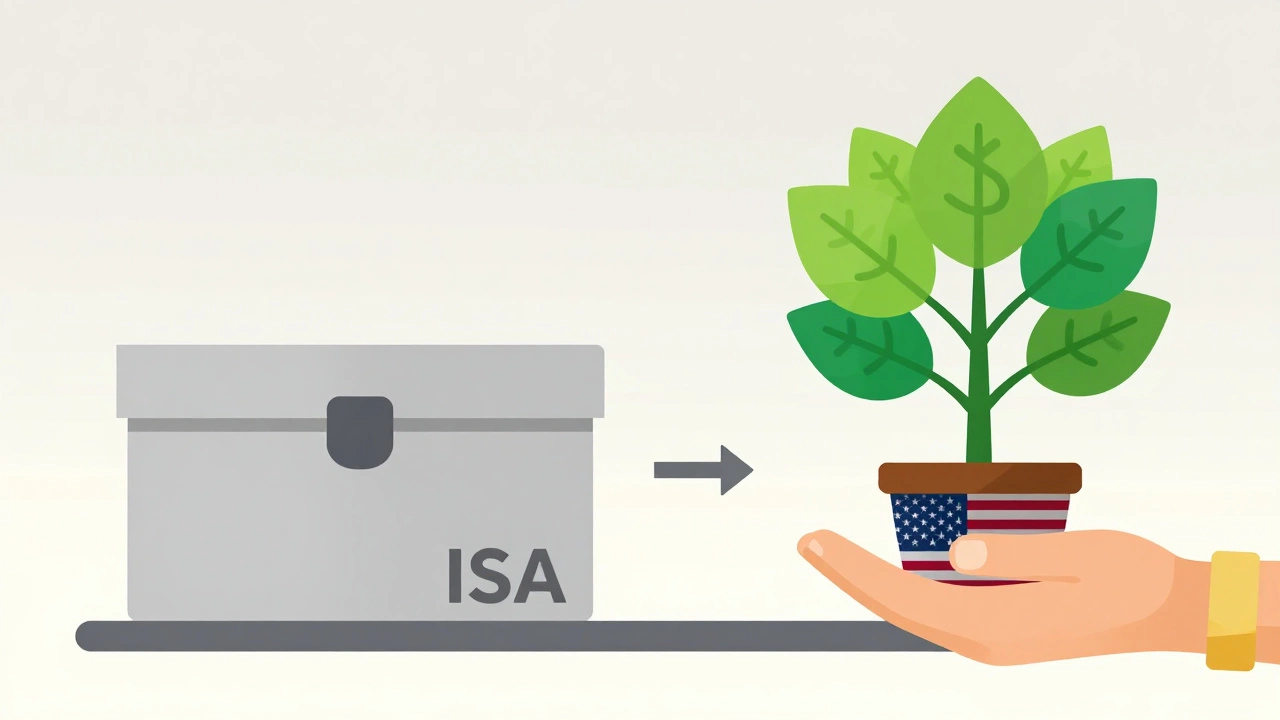
Better Alternatives for US-Based Savings
Since you can't contribute to a UK ISA, you should focus on US-based tax-advantaged accounts. If you have earned income in the US (from a job or self-employment), you can contribute to a Roth IRA, officially the Roth Individual Retirement Account, which is a US retirement account that allows tax-free growth and tax-free withdrawals in retirement. This is the closest equivalent to a Stocks and Shares ISA. Contributions are made with after-tax dollars, but all future growth is completely tax-free.
If your income is too high for a direct Roth IRA contribution, look into a "Backdoor Roth." This involves contributing to a Traditional IRA and then converting it to a Roth. There are pro-rata rules if you have other pre-tax IRAs, so check with a professional. For employer-sponsored plans, a 401(k), formally the Section 401(k) Plan, which is a deferred compensation plan that gives employees the option to elect current annual salary deferrals instead of increased taxable income, offers immediate tax deductions. These accounts do not require foreign asset reporting, making them much simpler for expats.
Practical Steps to Manage Your Situation
- Determine your UK tax residency status. Use the HMRC Statutory Residence Test online tool. If you are non-resident, stop contributing to the ISA.
- Check the value of your foreign assets. Add up your ISA, any other UK bank accounts, and international stocks. If it exceeds $50k/$75k, prepare for Form 8938.
- Consult a cross-border tax specialist. General CPAs often miss the nuances of deemed distributions from ISAs. You need someone familiar with both US and UK tax codes.
- Decide on closure vs. retention. If staying in the US long-term, consider liquidating the ISA to simplify reporting. If returning to the UK, keep it open and frozen.
- Open a Roth IRA. Start building tax-free wealth in the US system immediately. Maximize contributions each year.
Managing finances across borders is never simple, but clarity prevents costly mistakes. Your UK ISA is a relic of your past life, not a tool for your future in the US. Treat it accordingly: either preserve it for a potential return home or liquidate it to clean up your tax profile. Either way, shift your active saving efforts to US-based vehicles that align with your current residency.
Do I have to pay UK tax on my ISA if I live in the USA?
Generally, no. If you are non-resident in the UK, HMRC does not tax the growth inside your ISA. However, you must still report the assets to the IRS in the US, and the US may tax the deemed annual growth.
Can I transfer my UK ISA to a US 401(k)?
No, you cannot directly transfer funds from a UK ISA to a US 401(k). You would need to withdraw the funds from the ISA (triggering potential US capital gains tax) and then contribute to a 401(k) if your employer allows it, subject to annual contribution limits.
What happens if I forget to file Form 8938 for my ISA?
The IRS imposes a $10,000 penalty for each failure to file Form 8938. If you fail to file for more than 30 days after receiving a notice, the penalty can increase up to $60,000. It is crucial to include your ISA in your foreign asset reporting if the threshold is met.
Can I open a new UK ISA if I am a US citizen living in the UK?
Yes, if you are UK tax resident, you can open and contribute to a UK ISA. However, as a US person, you must still report the account to the IRS and pay US tax on the deemed distributions, negating the tax-free benefit for you personally.
Is my UK ISA protected by FDIC insurance?
No. The FDIC only insures deposits in US banks. UK ISAs are protected by the Financial Services Compensation Scheme (FSCS) in the UK, which covers up to £85,000 per person per authorized firm. This protection does not extend to US regulatory frameworks.