

Debt Payoff Strategy Simulator
Enter your current debts below to simulate how long it will take to pay them off using the two most popular strategies. The tool calculates total interest paid and payoff date for both methods.
Your Debts
Highest Interest First
Total Interest Paid:
$0
Time to Pay Off:
0 years, 0 months
Estimated End Date:
-
Smallest Balance First
Total Interest Paid:
$0
Time to Pay Off:
0 years, 0 months
Estimated End Date:
-
Verdict
Calculating...
Owning $60,000 in debt feels like carrying a backpack full of bricks up a steep hill. It’s heavy, it slows you down, and every step requires more energy than the last. You’re not alone in this feeling. Whether it’s student loans, credit card balances, or personal lines of credit, that number can seem insurmountable. But here’s the good news: it is absolutely possible to clear it. The key isn’t some secret financial hack; it’s a combination of strategic planning, behavioral changes, and consistent execution.
This guide breaks down exactly how to tackle that six-figure hurdle without losing your mind. We’ll look at why standard advice often fails, how to choose the right repayment strategy for your specific mix of debts, and what practical steps you can take starting today to see that balance drop.
The Psychology Behind Your Balance
Before we talk about interest rates and amortization schedules, let’s address the elephant in the room: shame. Many people with significant debt avoid looking at their statements because they fear what they might find. This avoidance creates a feedback loop. You don’t look, so you don’t know where the money goes, so you spend more, which increases the debt, which makes you want to hide again.
To break this cycle, you need to treat your debt as data, not a moral failing. When you sit down and list every single liability, you turn an emotional burden into a math problem. Math problems have solutions. Emotional burdens just weigh you down. Start by creating a master list. For each debt, write down:
- Creditor name
- Total outstanding balance
- Annual Percentage Rate (APR)
- Minimum monthly payment
- Due date
Seeing the total on one page is scary, but it’s also clarifying. Once you know the exact numbers, you can stop guessing and start planning. Remember, the goal isn’t to feel bad about the past; it’s to build a future where you aren’t paying thousands in interest every year.
Strategy Showdown: Avalanche vs. Snowball
There are two main methods for paying off multiple debts, and choosing between them is less about math and more about psychology. Both work, but they appeal to different personality types.
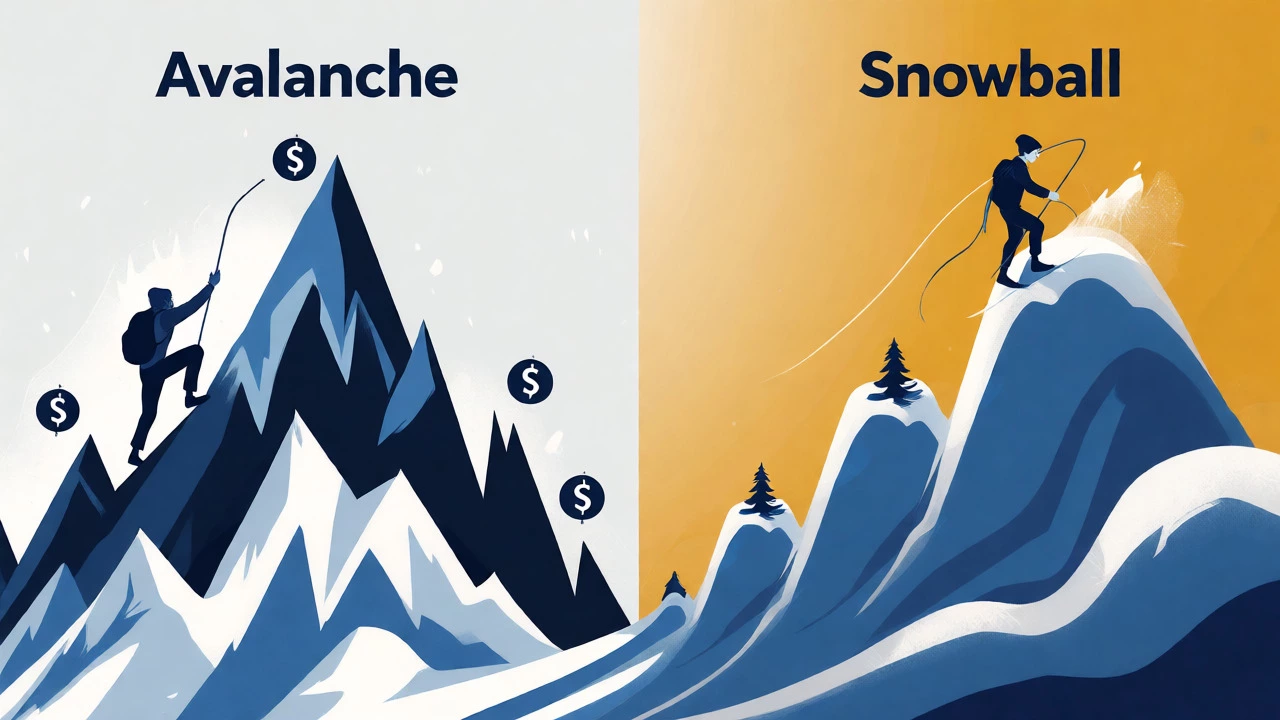
Debt Avalanche is the methodically superior approach from a purely financial standpoint. You list your debts by interest rate, highest to lowest. You pay the minimums on everything except the debt with the highest APR. Then, you throw every extra dollar you have at that high-interest debt. Once it’s gone, you roll that payment amount onto the next highest interest rate. Why does this work? Because high-interest debt grows faster. By attacking it first, you minimize the total interest paid over the life of the loan.
On the other hand, Debt Snowball focuses on momentum. You list your debts by balance size, smallest to largest. You ignore the interest rates for now. You pay off the smallest balance first, regardless of whether it has a 5% or a 25% interest rate. When that small debt disappears, you take the money you were paying on it and add it to the next smallest debt. This creates a psychological "win." Seeing a line item disappear from your statement provides a dopamine hit that keeps you motivated when progress on larger debts feels slow.
| Feature | Debt Avalanche | Debt Snowball |
|---|---|---|
| Primary Focus | Mathematical efficiency | Psychological motivation |
| Order of Payment | Highest Interest Rate First | Smallest Balance First |
| Total Interest Paid | Lowest | Slightly Higher |
| Time to First Win | Longer | Shorter |
| Best For | Disciplined savers who hate wasting money | People who need frequent encouragement |
Which one should you pick? If you’re disciplined and driven by saving money, go with Avalanche. If you’ve tried before and quit because you didn’t see results fast enough, try Snowball. The best plan is the one you actually stick to.
Consolidation: Simplify and Save
If you have five different credit cards and three personal loans, managing payments is a logistical nightmare. Missing a due date triggers fees and hurts your credit score. This is where Debt Consolidation comes in. Consolidation means taking out one new loan to pay off all your existing smaller debts. Now, instead of five payments, you make one.
But be careful. Consolidation only works if you lower your interest rate or shorten your term. If you consolidate a 24% APR credit card into a personal loan with a 12% APR, you save money. If you consolidate into a loan with a similar rate but extend the term from 3 years to 5 years, your monthly payment drops, but you might pay more interest overall.
Here’s a quick checklist before signing a consolidation loan:
- Compare Rates: Ensure the new APR is significantly lower than your weighted average current rate.
- Check Fees: Look for origination fees. Some lenders charge 1-8% upfront, which eats into your savings.
- Calculate Total Cost: Use an online calculator to compare the total interest paid under your current setup versus the consolidated loan.
- Close Old Accounts: Once the old debts are paid, close the credit card accounts (or freeze them) to prevent running up new charges while paying off the consolidation loan.
In New Zealand, for example, many banks offer debt consolidation products specifically designed to merge credit card limits into a single facility. Always read the fine print regarding early repayment penalties.
Aggressive Budgeting: Finding the Extra Cash
You can’t pay off $60,000 quickly if you’re spending everything you earn. To accelerate payoff, you need a gap between income and expenses. This doesn’t mean eating instant noodles for dinner every night, but it does mean being ruthless with discretionary spending.
Start with the 50/30/20 rule as a baseline, then tweak it. Typically, 50% of net income goes to needs, 30% to wants, and 20% to savings/debt. When tackling large debt, flip the script. Aim for 50% needs, 20% wants, and 30% debt repayment. Here’s where to cut:
- Subscriptions: Audit your bank statement. Cancel streaming services, gym memberships, or app subscriptions you haven’t used in two months. That’s easily $50-$100 a month.
- Dining Out: Cooking at home saves an average of $20 per meal compared to restaurant prices. Limit dining out to once a week as a reward, not a habit.
- Utility Bills: Call your internet and mobile providers. Ask for retention offers. Threatening to switch providers often unlocks discounts worth $10-$20 a month.
- Impulse Buys: Implement a 24-hour rule. If you want to buy something non-essential, wait 24 hours. Often, the urge passes.
Every dollar you save from these cuts goes directly toward the principal balance of your targeted debt. Don’t let inflation eat your gains; keep your lifestyle fixed even if your income rises.

Boosting Income: The Accelerator
Budgeting has a floor-you can only cut so much. Income, however, has no ceiling. To pay off $60,000 in a reasonable timeframe (say, 3-5 years), you likely need to increase cash flow.
Consider these options:
- Overtime: If your job offers paid overtime, take it. This is immediate cash with no additional commuting time.
- Side Hustles: Platforms like Uber, DoorDash, or TaskRabbit allow you to monetize free time. Even working 10 hours a week at $25/hour adds $1,000 a month to your debt fund.
- Sell Unused Items: Look around your house. Do you have electronics, clothes, or furniture you don’t use? Selling these items on local marketplaces provides a lump sum injection. Put 100% of this money toward debt.
- Ask for a Raise: If you’ve been productive and haven’t had a raise in over a year, prepare a case for one. Document your achievements and ask for a meeting. A 5% raise on a $60,000 salary is $3,000 a year-significant when directed at debt.
Treat this extra income as "found money." Don’t upgrade your car or buy new clothes. Channel it entirely into the debt avalanche or snowball.
Maintaining Momentum
Paying off debt is a marathon, not a sprint. There will be months when you want to quit. Maybe your car breaks down, or you have a medical emergency. These setbacks are normal. The key is resilience.
Set milestones. Celebrate when you pay off your first credit card. Celebrate when you reach $50,000 remaining. These celebrations shouldn’t cost money-a nice movie night at home or a hike in the hills works great.
Also, protect your progress. As you pay down debt, your credit utilization ratio improves, which boosts your credit score. Lenders may start offering you more credit. Be wary. Don’t open new credit cards unless necessary. Keep your focus on becoming debt-free, not accumulating more purchasing power.
Finally, automate your payments. Set up automatic transfers from your checking account to your debt accounts on payday. This removes the decision fatigue of manually transferring funds. If the money leaves automatically, you learn to live on what remains.
Is it better to pay off debt or invest?
Generally, if your debt interest rate is higher than the expected return on your investments, pay off the debt first. Credit card debt often carries rates above 15%, while historical stock market returns average around 7-10%. Paying off high-interest debt guarantees a risk-free return equal to the interest rate saved. However, always contribute enough to any employer retirement match, as that is an immediate 100% return.
Can I negotiate my interest rates?
Yes, especially for credit cards. Call your issuer, explain your situation, and mention that you are considering transferring your balance to a competitor with a lower rate. They may offer a promotional rate reduction to keep you as a customer. This is known as "rate matching" or retention negotiation.
What happens if I miss a payment?
Missing a payment can trigger late fees and penalty APRs, which can spike your interest rate significantly. It also reports negatively to credit bureaus after 30 days. If you anticipate missing a payment, call your lender immediately. Many have hardship programs that allow temporary forbearance or modified payment plans.
Should I use a balance transfer card?
Balance transfer cards offer 0% APR for a introductory period (usually 12-21 months). This is excellent if you have high-interest credit card debt and can pay it off within the intro period. Watch out for transfer fees, typically 3-5% of the transferred amount. Calculate if the fee plus the remaining balance fits within your timeline.
How long does it take to pay off $60,000?
It depends on your monthly payment. At $1,000/month with an average 10% interest rate, it takes roughly 7 years. At $2,000/month, it takes about 3.5 years. Aggressive strategies involving side hustles and strict budgeting can reduce this to 2-3 years. The variable is your disposable income.