

Social Security & Retirement Gap Calculator
Estimated Monthly Benefit
The Savings Gap
Based on your selected age and expenses, you need an additional $1,500 per month from personal savings.
Using the 4% safe withdrawal rule, you would need approximately:
You earn $60,000 a year. It sounds like a solid middle-class income. You pay your taxes, you save a little, and you assume the government will take care of you when you stop working. But here is the hard truth: Social Security was never designed to replace your full salary. If you rely on it as your only source of income in retirement, you might be shocked by the math.
So, how much will you actually get? The short answer is that if you make $60,000 every year for 35 years and retire at full retirement age (around 67), you can expect roughly $1,400 to $1,600 per month. That is not enough to live on comfortably in most parts of the United States today. To understand why, we need to look past the paycheck and into the mechanics of the system.
The Myth of the Straight-Line Calculation
Most people think Social Security works like a savings account. They believe that because they paid in X amount, they will get out Y amount. It doesn't work that way. Social Security is a progressive tax-based benefit program funded by current workers' payroll taxes. It is not an individual investment account. Your benefits are calculated based on your earnings history, but the formula is designed to replace a higher percentage of income for low earners than for high earners.
If you made $20,000 a year, Social Security might replace 50-60% of that income. If you make $60,000, it replaces about 30-40%. If you make $200,000, it replaces less than 20%. This is intentional. The system aims to prevent poverty in old age, not to maintain your pre-retirement lifestyle. Understanding this gap is the first step in realistic retirement planning.
How Your $60,000 Salary Translates Into Benefits
To estimate your benefit, the Social Security Administration (SSA) looks at your highest 35 years of earnings. If you have fewer than 35 years of work history, those missing years count as zeros, which drags down your average. Let's assume you work consistently until age 67.
First, your earnings are "indexed" for inflation. This means your $60,000 from 2026 is adjusted to reflect what that money would be worth in today's dollars when you reach retirement age. Then, the SSA calculates your Average Indexed Monthly Earnings (AIME). For a $60,000 annual salary, your monthly average is roughly $5,000.
Next comes the Primary Insurance Amount (PIA). This is where the progressive formula kicks in. The SSA applies different percentages to different portions of your AIME:
- 92.3% of the first $1,174 of your AIME (in 2024 terms).
- 32.0% of the amount between $1,174 and $7,078.
- 15.0% of any amount above $7,078.
Since your $5,000 monthly average falls into the second bracket, you get a decent boost from the first chunk, but the rest is taxed at a lower rate. When you run the numbers, this typically results in a monthly benefit around $1,450 to $1,550 if you claim at full retirement age. If you wait until age 70, that number could climb toward $1,800 due to delayed retirement credits. If you claim early at 62, it could drop below $1,100.
| Claiming Age | Reduction Factor | Estimated Monthly Benefit |
|---|---|---|
| 62 (Earliest) | -25% to -30% | $1,050 - $1,150 |
| 67 (Full Retirement Age) | 0% | $1,450 - $1,550 |
| 70 (Maximum Delay) | +24% | $1,800 - $1,900 |

The Hidden Cost: Taxes on Your Benefits
Here is another twist that catches many retirees off guard. Your Social Security benefits might be taxable. While the benefits themselves are often considered "tax-free," the IRS uses a formula called "provisional income" to determine if you owe taxes on them.
If you file as an individual and your provisional income (adjusted gross income + nontaxable interest + 50% of Social Security benefits) is between $25,000 and $34,000, up to 50% of your benefits may be taxable. If it exceeds $34,000, up to 85% can be taxed. If you file jointly with a spouse who also earns income or has other investments, that threshold jumps to $32,000 and $44,000 respectively.
This means that even if you receive $1,500 a month, your take-home pay might be closer to $1,200 after federal taxes. State taxes vary; some states tax Social Security, while others exempt it entirely. Always check your local state laws.
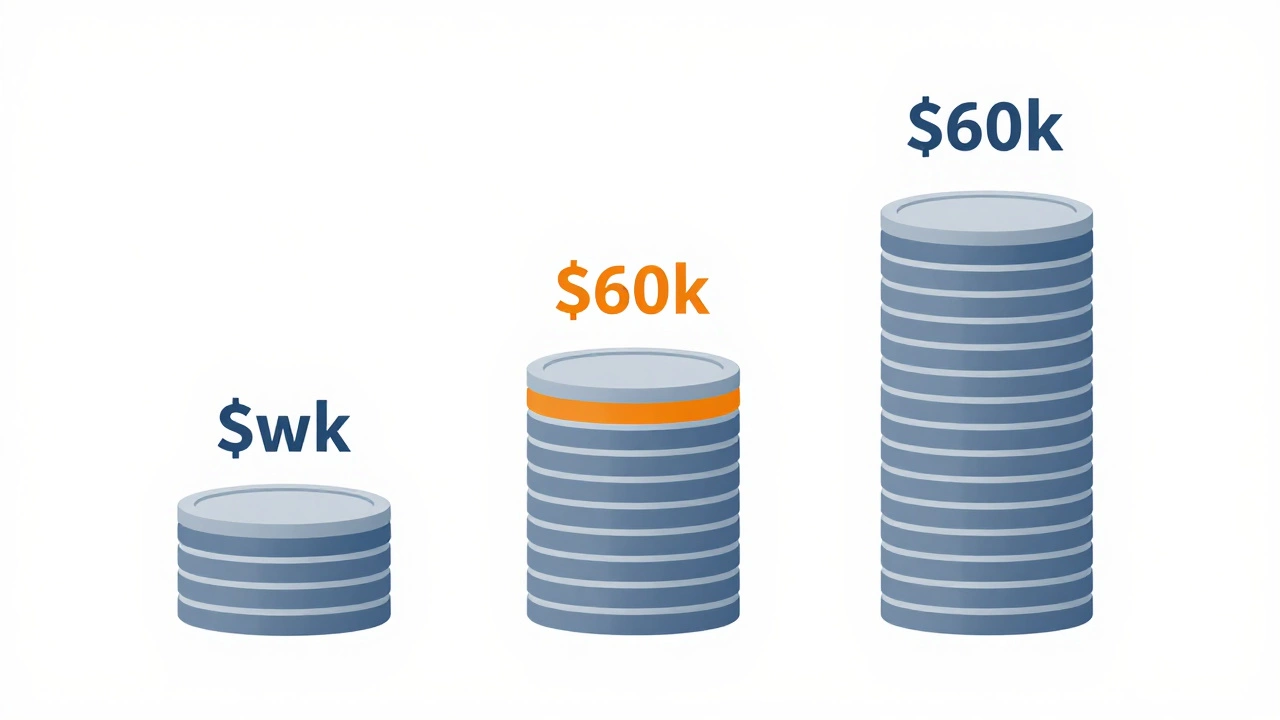
Why ,000 Isn't Enough to Retire On Alone
Let's put that $1,500 monthly benefit into perspective. According to recent data, the median rent for a one-bedroom apartment in the U.S. is over $1,200. Add utilities, groceries, healthcare, and transportation, and you are quickly looking at a budget shortfall. Social Security covers basic needs, but it does not cover comfort.
This is why financial advisors often recommend the "4% rule." This rule suggests that you should have enough saved in personal investments to cover the gap between your Social Security income and your desired lifestyle. If you want to spend $3,000 a month in retirement, and Social Security provides $1,500, you need another $1,500 from your own savings. To generate $1,500 a month safely (without depleting your principal too fast), you would need roughly $450,000 invested.

Strategies to Maximize Your Payout
You cannot change the law, but you can optimize your strategy. Here are three concrete steps to ensure you get the most out of the system:
- Work Until Full Retirement Age or Later: Every month you delay claiming benefits past your full retirement age increases your payout by about 8% per year until age 70. This is a guaranteed return that few investments can match.
- Fill in the Gaps: If you took time off for childcare, education, or unemployment, try to work more years to replace those "zero" years in your 35-year calculation. Even a modest increase in your average indexed earnings can bump up your monthly benefit.
- Coordinate with a Spouse: If you are married, your filing strategy affects both of you. One spouse might claim early to provide immediate cash flow, while the other delays to maximize their benefit and leave a larger survivor benefit for the remaining spouse.
The Bigger Picture: Don't Ignore Personal Savings
Relying solely on Social Security is risky. Inflation erodes purchasing power over time. While Social Security has cost-of-living adjustments (COLAs), these do not always keep pace with the rising costs of healthcare and housing. The most powerful tool you have is time. Starting a Roth IRA or contributing to a 401(k) now, even with small amounts, compounds significantly over decades.
If you make $60,000 a year, aim to contribute at least 10-15% of your income to retirement accounts. If your employer offers a match, take it-that is free money. Diversify your savings across stocks, bonds, and real estate to mitigate risk. Social Security is the floor, not the ceiling, of your retirement income.
Will I get my social security back if I die before collecting it?
Generally, no. Social Security is not an insurance policy that refunds premiums upon death. However, your surviving spouse or minor children may be eligible for survivor benefits. Additionally, if you have paid into the system for at least six months, your beneficiary can receive a one-time lump-sum payment of $255.
Does earning $60,000 affect my eligibility for Medicare?
No, earning $60,000 does not disqualify you from Medicare. Everyone who has worked and paid Medicare taxes for at least 10 years (40 quarters) is eligible for premium-free Part A (hospital insurance) at age 65. However, higher incomes may lead to higher premiums for Part B (medical insurance) and Part D (prescription drugs) due to Income-Related Monthly Adjustment Amounts (IRMAA).
Can I still work and collect Social Security at the same time?
Yes, but there are limits. If you claim benefits before your full retirement age, your benefits will be reduced if you earn more than a certain limit ($22,320 in 2024 for those under full retirement age). Once you reach full retirement age, you can earn any amount without penalty. Working longer also helps replace lower-earning years in your benefit calculation.
How accurate is the SSA online estimator?
The SSA's online statement and calculator are quite accurate for past earnings but less precise for future projections. They assume your earnings will remain constant in real terms, which may not happen if you switch careers, get promoted, or face economic downturns. Use it as a baseline, but consider running scenarios with different income levels.
What happens if I haven't worked 35 years?
If you have fewer than 35 years of earnings, the SSA fills the missing years with zeros. This lowers your Average Indexed Monthly Earnings (AIME) and reduces your final benefit. For example, if you only worked 20 years, 15 years of zeros will significantly drag down your average. Continuing to work adds positive earnings years to replace those zeros.