
Car Loan Cost Comparison Tool
Monthly Payment: $0
Total amount to be repaid: $0
| Scenario | APR | Total Interest | Difference |
|---|
Enter your loan details and click "Analyze" to see how your APR compares to 2026 benchmarks.
Quick Takeaways
- Excellent credit (780+) can often snag rates below 5% for new cars.
- Average rates for used cars are typically 2-4% higher than new cars.
- APR includes more than just interest; it covers the total cost of borrowing.
- Manufacturer incentives (like 0% APR) are powerful but often require a massive down payment or a short term.
The Real Meaning of APR
Before hunting for a number, you need to understand what you're actually looking at. Most people use "interest rate" and "APR" interchangeably, but they aren't the same. APR is the Annual Percentage Rate, which represents the total yearly cost of a loan, including the interest rate and any mandatory fees. It is the gold standard for comparing loans because it prevents lenders from hiding costs in "origination fees" or "processing charges."
Think of it like this: the interest rate is the price of the money, but the APR is the price of the loan. If a dealer offers you a 4% interest rate but tacks on a $500 documentation fee, your actual APR will be higher than 4%. Always ask for the APR when comparing offers; it's the only way to see the true cost of the deal.
What Actually Counts as a "Good" Rate?
In 2026, a "good" rate depends heavily on your Credit Score is a numerical expression based on a level of creditworthiness, used by lenders to determine the risk of lending. . Lenders view your score as a probability map of whether you'll pay them back. If you're a low-risk borrower, you get the reward of a lower rate.
For a brand new car, a rate under 5% is generally considered excellent. If you're sitting in the 6% to 9% range, you're seeing a fairly standard "average" rate for someone with a decent credit history. Once you cross the 12% mark, you're entering "subprime" territory, where the loan starts to become a significant financial burden. To put this in perspective, a 15% APR on a $30,000 loan can add thousands of dollars to the total cost of the car compared to a 5% loan.
| Credit Tier | Score Range | Approx. Good APR |
|---|---|---|
| Super Prime | 780 - 850 | 3.5% - 5.0% |
| Prime | 660 - 779 | 5.5% - 8.5% |
| Non-Prime | 600 - 659 | 9.0% - 13.0% |
| Subprime | Below 600 | 14.0% - 21.0% |
New vs. Used Car Finance Logic
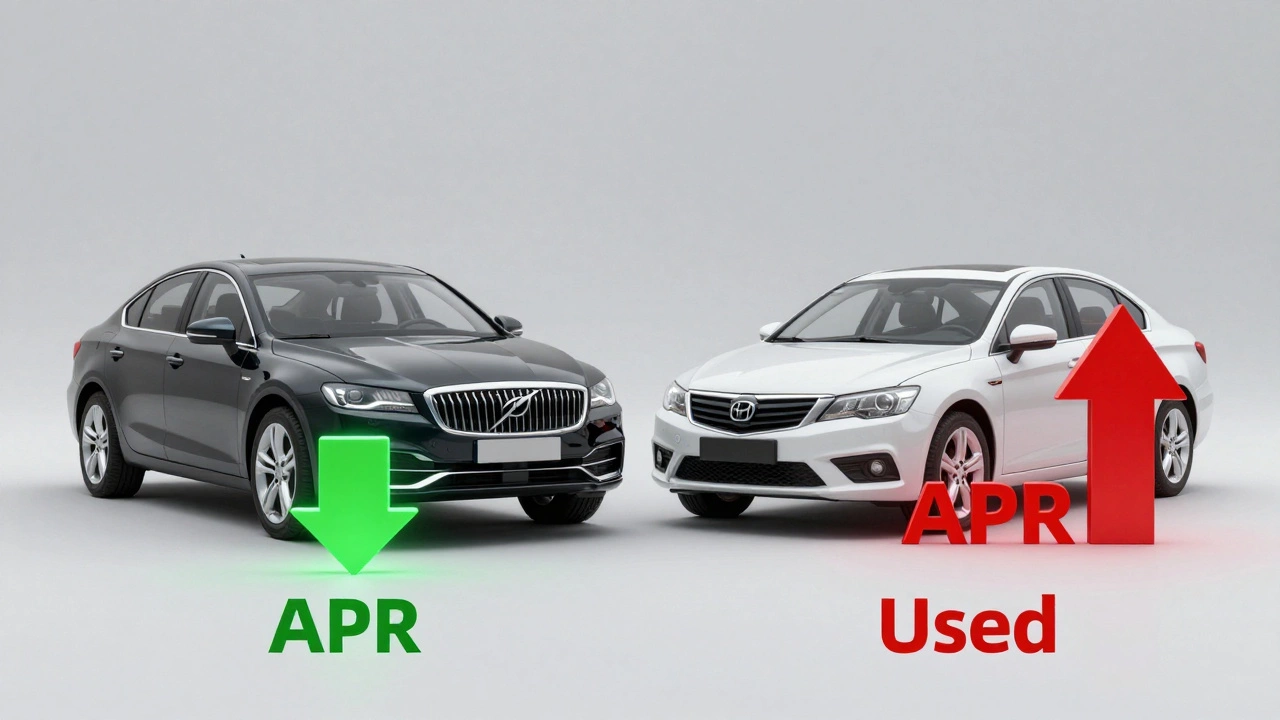
You'll notice that rates for used cars are almost always higher. Why? Because Used Car Loans are financing options for pre-owned vehicles, which carry higher risk for lenders due to depreciation and unknown vehicle history. a used car is a riskier asset. If you stop paying, the bank has to repossess a car that is already losing value quickly.
Usually, you can expect a used car APR to be 2% to 4% higher than a new car APR for the same credit score. If you're getting a 4% rate on a 2026 model, don't be surprised if a 2022 model of the same car comes with a 7% rate. This is why some people actually find it cheaper per month to buy new, even though the sticker price is higher, because the financing is so much more favorable.
The 0% APR Trap
We've all seen those flashy ads shouting "0% APR Financing!" It sounds like a miracle, but there's always a catch. These are usually Manufacturer Incentives are promotional offers provided by car brands to move inventory quickly by offering subsidized loan terms.
Here is the reality: 0% APR is typically reserved for the "super prime" crowd. If your credit isn't perfect, you won't qualify. Even if you do, you'll often have to choose between 0% APR and a cash-back rebate. For example, a dealer might offer 0% financing OR $3,000 cash off the price. If you have the cash to make a large down payment, taking the rebate and a slightly higher APR from a credit union might actually save you more money over the life of the loan.
Where to Get the Best Rates
Most people make the mistake of letting the dealership handle the financing. While convenient, dealerships often add a "markup" to the interest rate the bank gives them. If the bank approves you for 5%, the dealer might tell you the best they can do is 6.5% and pocket the difference.
To avoid this, start with Credit Unions are member-owned financial cooperatives that often provide lower loan rates and more personalized service than big banks. . Because they are non-profits, they often have lower overhead and can offer more competitive rates. Another great option is a pre-approved loan from your primary bank. When you walk into the dealership with a pre-approval letter for 5.5% APR, you've effectively turned yourself into a cash buyer. Now, the dealer has to beat that rate to get your business.
How the Loan Term Affects Your APR
The length of your loan-the term-changes the math significantly. In recent years, 72-month and 84-month loans have become common. While this makes the monthly payment look small, it's a dangerous game. Lenders often charge a higher APR for longer terms because there is more time for things to go wrong.
More importantly, a long-term loan increases the risk of being "underwater." This happens when you owe more on the loan than the car is actually worth. Since cars depreciate the moment they leave the lot, a 7-year loan often means you'll be paying for a car that has already lost half its value. A "good" rate on an 84-month loan is still a bad financial move compared to a slightly higher rate on a 48-month loan.
Checklist for Negotiating Your Rate
- Check your credit report: Look for errors that might be dragging your score down before you apply.
- Get three quotes: Compare your bank, a local credit union, and the dealership.
- Focus on the total cost: Don't just look at the monthly payment; look at the total interest paid over the life of the loan.
- Ask about pre-payment penalties: Ensure you can pay the loan off early without being charged a fee.
- Compare the rebate vs. low APR: Do the math to see if a cash discount is better than a lower interest rate.
Can I refinance my car loan if rates drop?
Yes, you can. Refinancing involves taking out a new loan with a lower APR to pay off the old one. This is a great move if your credit score has improved significantly since you bought the car or if the general market rates have fallen. Just make sure the new loan doesn't have a high origination fee that cancels out the interest savings.
Does a larger down payment lower my APR?
Indirectly, yes. While the down payment doesn't change your credit score, it changes the "Loan-to-Value" (LTV) ratio. Lenders feel safer when you have more "skin in the game." If you put 20% down, the lender has less risk, which can sometimes help you negotiate a slightly better rate or get approved for a loan you otherwise wouldn't have.
What is the difference between a fixed and variable APR?
A fixed APR stays the same for the entire life of the loan, giving you a predictable monthly payment. A variable APR can change based on the market (usually tied to the prime rate). While variable rates can start lower, they are risky because your payment could jump significantly if the economy changes.
Is 10% APR considered a bad rate for a car?
For a new car, 10% is generally considered poor. For a used car, it's more common but still on the higher side. If you're seeing 10% or more, it's a signal to either improve your credit score, find a co-signer, or look for a cheaper vehicle to lower the loan amount.
How does the car's age affect the APR?
The older the car, the higher the rate. Most lenders have a limit on the age of the vehicle they will finance (often 10 years). As the car gets older, the risk of mechanical failure increases, making it a less secure collateral for the bank, which results in a higher APR to offset that risk.
Next Steps: How to Get Your Rate Down
If the rates you're being quoted feel too high, you have a few levers you can pull. First, try to find a co-signer with a stronger credit profile. This can instantly drop your APR by several percentage points because the lender now has two people responsible for the debt.
Second, look at your loan term. Shortening a loan from 72 months to 48 months often unlocks lower interest rates. While the monthly payment will be higher, you'll save a massive amount of money in interest over time. Finally, if you're stuck with a high rate, focus on making extra payments toward the principal. Most car loans are "simple interest," meaning the less you owe, the less interest you pay every month.