

$1,000 Loan Cost Calculator
Scenario: You need exactly $1,000. Select a loan type below to see how much you will actually pay back over time based on typical rates mentioned in the article.
Federal Direct Loan
Best RateNo credit check required. Fixed rates set by Congress.
- ✓ Subsidized option available
- ✓ No credit score needed
- ✗ Slow disbursement
Private Student Loan
Co-signer Often NeededHigher hurdles for small amounts. Requires good credit or co-signer.
- ✓ Faster than federal
- ✓ Fixed or variable options
- ✗ High minimums ($2k+)
Personal Loan
Fastest FundingEasy to get if you have income. Rates depend heavily on credit score.
- ✓ Funds in 1-3 days
- ✓ No collateral needed
- ✗ Payments start immediately
Credit Union
Member BenefitsNon-profit structure often leads to lower fees and flexible terms.
- ✓ Lower overhead costs
- ✓ Flexible approval
- ✗ Must be eligible member
Payday Loan
AVOID THISPredatory lending. Designed to trap borrowers in cycles of debt.
- ✓ Instant cash
- ✓ No credit check
- ✗ Extremely high fees
Calculate Repayment
Projected Cost Breakdown
Principal Amount
Total Interest Paid
Total Repayment
Federal loans offer the lowest rates but may take weeks to arrive. Ideal for planned expenses like textbooks.
You need exactly $1,000. Maybe it’s for textbooks that are suddenly required mid-semester, a laptop repair before finals, or covering rent while you wait for your financial aid disbursement. It feels like a small amount, but without it, your academic progress stalls. You might assume that student loans are only for massive tuition bills at private universities. The reality is different. Yes, you can get a $1,000 student loan, but the path to getting one depends entirely on whether you qualify for government aid first.
Borrowing money for school is a serious decision. Even a small loan adds interest over time. Before you sign anything, you need to understand the hierarchy of funding. The goal is always to borrow the least amount possible from the most expensive sources last. Here is how to secure that $1,000 responsibly.
The First Stop: Federal Direct Loans
If you are enrolled in an eligible college or career school in the United States, your first option should always be federal aid. Many students overlook this because they think federal loans are automatic or only for large sums. However, the Federal Direct Loan Program allows you to borrow specific amounts based on your year in school and dependency status.
For undergraduate students, the annual limit for dependent freshmen is typically $5,700 (with a maximum of $3,100 in subsidized loans). This means if you have not used any of that limit yet, you can certainly request just $1,000. You do not have to take the full amount. You simply fill out the FAFSA (Free Application for Federal Student Aid), and when your award letter arrives, you can choose to accept a smaller portion of the loan offered.
Why start here? The interest rates are fixed by Congress and often lower than market rates. For loans disbursed between July 1, 2024, and June 30, 2025, the rate for undergraduates was 6.54%. More importantly, there is no credit check for direct loans. Your credit score does not matter. If you are a dependent student, your parents’ income matters more than their credit history. This makes federal loans the safest bet for a small, urgent cash need.
When Federal Aid Isn't Enough: Private Student Loans
If you have exhausted your federal eligibility, or if you are an independent student who needs additional funds, you might look at private lenders. Getting a $1,000 private student loan is possible, but it comes with significant hurdles. Most major banks and online lenders have minimum loan amounts. Some require a minimum of $2,000 or even $5,000. Finding a lender willing to process a $1,000 loan specifically labeled as a "student loan" can be tricky because the administrative costs for them are high relative to the payout.
Furthermore, private loans usually require a good credit score. If you are a new college student, you likely lack a long credit history. In this case, you will almost certainly need a co-signer. A co-signer is usually a parent or guardian with excellent credit who agrees to repay the loan if you default. Without a co-signer, approval for a small private student loan is rare, and the interest rates could be punishingly high-sometimes exceeding 15% APR.
Before applying, check the lender’s minimums. Lenders like Sallie Mae, Earnest, or SoFi may not offer a standalone $1,000 student loan product. They might bundle it into a larger educational expense package, which isn’t helpful if you strictly need a thousand dollars now.
The Smarter Alternative: Personal Loans
Here is where many people make a mistake: they search for "small student loans" when they should be searching for "small personal loans." If you have a job, a steady income, or decent savings, a personal loan is often easier to get for a $1,000 amount than a specialized student loan.
Personal loans are unsecured, meaning you don’t need collateral. They are designed for various expenses, including education-related costs. Many online lenders, such as Upstart, Avana Credit, or even your local bank, offer personal loans starting at $1,000. The application process is fast-often approved within minutes-and the funds can hit your account in days.
However, compare the interest rates carefully. A personal loan’s rate depends heavily on your credit score. If you have a fair credit score (around 600-650), you might face an APR of 18% to 25%. Compare this to the federal student loan rate mentioned earlier. If the personal loan rate is significantly higher, it becomes a costly shortcut. Use this option only if you can pay it back quickly, ideally within 12 to 24 months, to minimize interest accumulation.
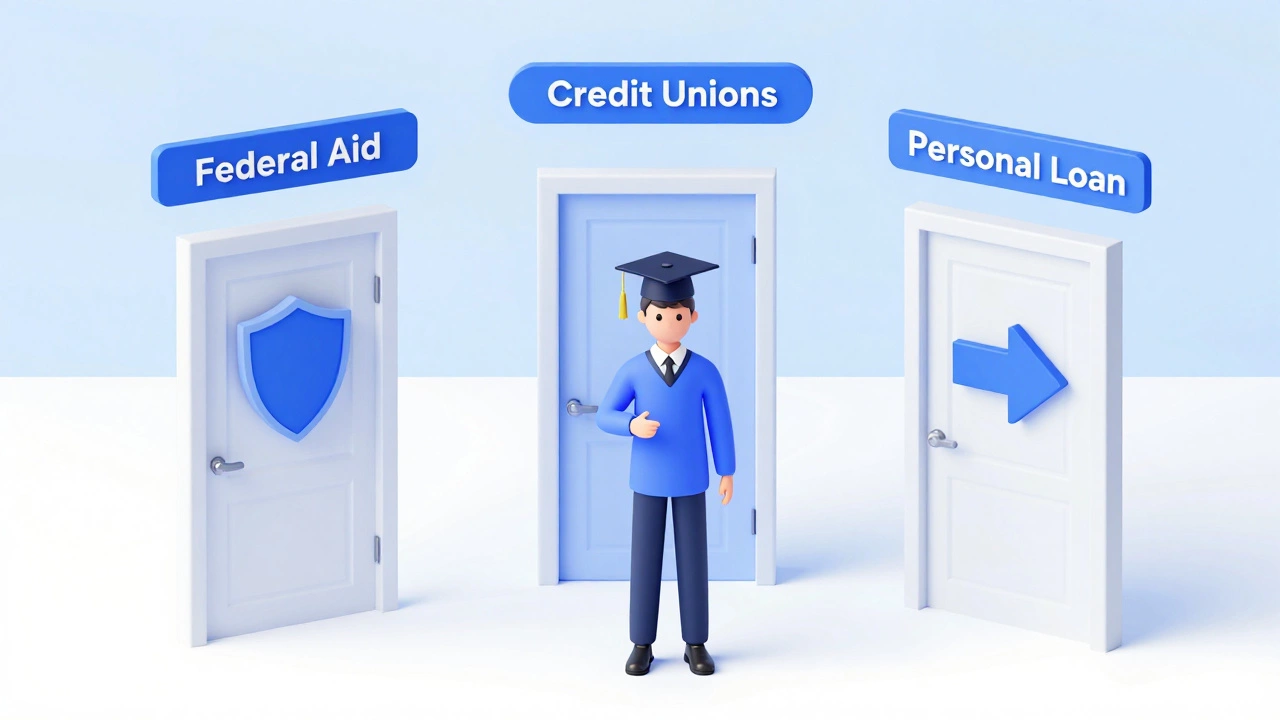
Credit Unions: The Underrated Option
If you want better rates than big banks and more flexibility than online-only lenders, consider a credit union. Credit unions are member-owned non-profits. They often have community-focused lending products, including small-dollar loans for education or emergency needs.
Many credit unions offer "Share Secured Loans" or small personal loans with minimums as low as $500 or $1,000. Because they are non-profit, their overhead is lower, which can translate to lower interest rates for members. Additionally, credit union staff are often more willing to work with young borrowers or those with thin credit files, especially if you are already a member through your university or employer.
To use this option, you must be eligible to join the credit union. University-affiliated credit unions are common. Check if your school has a partnership with a local credit union. Joining usually requires a small deposit (e.g., $5-$25) and proof of enrollment or employment.
Avoiding the Trap: Payday and Title Loans
Desperation can lead to bad decisions. You might see advertisements for quick cash with "no credit check" promises. These are often payday loans or installment loans from predatory lenders. Do not touch these for education expenses.
Payday loans charge exorbitant fees that equate to APRs of 300% to 400%. Borrowing $1,000 could mean repaying $1,300 or more in just two weeks. If you cannot repay it, the cycle of debt begins, making your financial situation far worse than the original textbook cost. These loans do not report positive payment history to credit bureaus but will severely damage your credit if you miss a payment. Stick to regulated financial institutions.
Non-Loan Alternatives to Consider First
Before taking on any debt, ask yourself if a loan is truly necessary. There are several ways to cover a $1,000 gap without borrowing:
- Scholarships and Grants: Search for micro-scholarships. Websites like Going Merry or Scholarships.com often have small awards ($500-$1,000) with less competition than large national scholarships.
- Textbook Rentals or E-books: Instead of buying new books, rent them or use library reserves. This can save hundreds of dollars instantly.
- Work-Study Programs: If you qualified for Federal Work-Study on your FAFSA, you can earn money through on-campus jobs. This is essentially paid labor, not debt.
- Emergency Aid Funds: Many colleges have emergency grant funds for students facing unexpected expenses. Contact your financial aid office. They may offer a one-time grant rather than a loan.
Decision Matrix: Which Path Is Right for You?
| Option | Best For | Credit Check Required? | Typical Interest Rate | Speed of Funds |
|---|---|---|---|---|
| Federal Direct Loan | Eligible students with FAFSA filed | No | Fixed (~6.5% for undergrads) | Slow (weeks to months) |
| Private Student Loan | Students with strong credit/co-signer | Yes | Variable/Fixed (5%-15%) | Moderate (days to weeks) |
| Personal Loan | Those with steady income/good credit | Yes | Variable (8%-35%) | Fast (1-3 days) |
| Credit Union Loan | Members seeking lower rates | Yes (but flexible) | Fixed/Variable (6%-18%) | Moderate (few days) |
| Payday Loan | Avoid completely | No | Extremely High (300%+ APR) | Instant |
Steps to Secure Your $1,000 Responsibly
- Check Your Financial Aid Award: Log in to your student portal. See if you have unused federal loan eligibility. If yes, contact your financial aid office to adjust your acceptance amount.
- Contact Your School’s Emergency Fund: Ask if they offer grants for short-term hardships. This is free money, so prioritize it.
- Explore Credit Unions: If you need money faster than federal aid provides, visit a local credit union. Bring proof of enrollment and income.
- Compare Personal Loans: If you have good credit, use comparison sites to find personal loans with low APRs. Look for lenders with no origination fees.
- Budget the Repayment: Calculate the monthly payment. For a $1,000 loan at 10% APR over 3 years, you’ll pay about $32/month. Ensure this fits your budget.
Getting a $1,000 student loan is feasible, but it requires navigating the right channels. Avoid the temptation of quick, high-interest alternatives. By leveraging federal programs, credit unions, or responsible personal loans, you can cover immediate educational expenses without derailing your long-term financial health.
Can I get a student loan with bad credit?
Yes, but primarily through federal Direct Loans, which do not require a credit check. Private student loans usually require a good credit score or a co-signer with excellent credit. If you have bad credit and no co-signer, a personal loan from a credit union or a secured loan might be your only viable options, though rates will be higher.
What is the minimum amount for a federal student loan?
There is no strict minimum dollar amount set by the Department of Education for federal loans, but you must borrow at least enough to cover your Cost of Attendance minus other financial aid. Practically, you can borrow as little as $100 if your school’s financial aid office approves the adjustment, though processing very small amounts may vary by institution.
How long does it take to get a $1,000 personal loan?
Online personal lenders can approve and fund a $1,000 loan within 24 to 48 hours after application. Traditional banks or credit unions may take 3 to 5 business days due to manual review processes. Always check the lender’s stated funding timeline before applying.
Is it worth taking a loan for just $1,000?
It depends on the alternative. If the $1,000 prevents you from registering for classes or buying essential materials that directly impact your degree completion, then yes, it is worth it. However, if it is for non-essential items, try to save up or use non-debt resources like scholarships or part-time work to avoid interest costs.
Do I have to pay back a $1,000 student loan immediately?
For federal subsidized loans, repayment generally begins six months after you graduate or drop below half-time enrollment. For unsubsidized federal loans and most private loans, interest accrues while you are in school, but payments are often deferred until after graduation. Personal loans typically require monthly payments to begin immediately upon funding.