

Compound Interest Calculator
Calculate Your Future Savings
Your Future Savings
Total Contributed:
$0
Interest Earned:
$0
Final Amount:
Starting with $100/month for 30 years at 7% interest:
You'll have $121,000 total (more than $85,000 in compound interest).
If you save $100 a month for 30 years, you’ll put in $36,000 of your own money. But that’s not what you’ll end up with. Thanks to compound interest, you could have over $100,000-maybe even more. It’s not magic. It’s math. And it’s something anyone can do, no matter how little they think they can spare.
What happens when you save $100 a month for 30 years?
Let’s break it down. Saving $100 every month for 30 years adds up to $36,000. That’s $1,200 a year. Sounds simple. But if that money grows, even slowly, the total jumps up. Why? Because of compound interest. That’s when your money earns interest, and then that interest earns interest too.
Here’s the real number: if you earn an average annual return of 7%, which is close to the long-term average of the S&P 500, you’ll have about $121,000 after 30 years. That’s more than triple what you put in. If you earn 5%, you’ll have around $83,000. At 9%, you’ll hit nearly $180,000.
That’s not a guess. That’s based on the future value of an ordinary annuity formula: FV = P × [((1 + r)^n - 1) / r], where P is the monthly payment ($100), r is the monthly interest rate (annual rate divided by 12), and n is the total number of payments (360). Plug in the numbers, and you get the result.
Why 7% is the magic number
People talk about 10% returns, but that’s not realistic for most savers. The S&P 500 has returned about 7% to 8% annually after inflation since 1926. That’s the number financial planners actually use when building long-term plans. If you’re putting money into a low-cost index fund or a target-date retirement fund, 7% is a safe, realistic expectation.
Bank savings accounts? Those pay less than 1% right now. If you keep your $100 a month in a savings account earning 0.5%, you’ll have just $38,000 after 30 years. That’s $2,000 more than you put in. Not even close to what you could have.
So where you put the money matters more than how much you save. $100 a month in a high-yield investment account beats $200 a month in a low-interest savings account over time. The growth wins.
Start early-even if you’re behind
Time is your biggest advantage. If you start at 25, you have 30 years. If you start at 35, you only have 20. That 10-year gap cuts your final amount by almost half-even if you keep saving the same $100 a month.
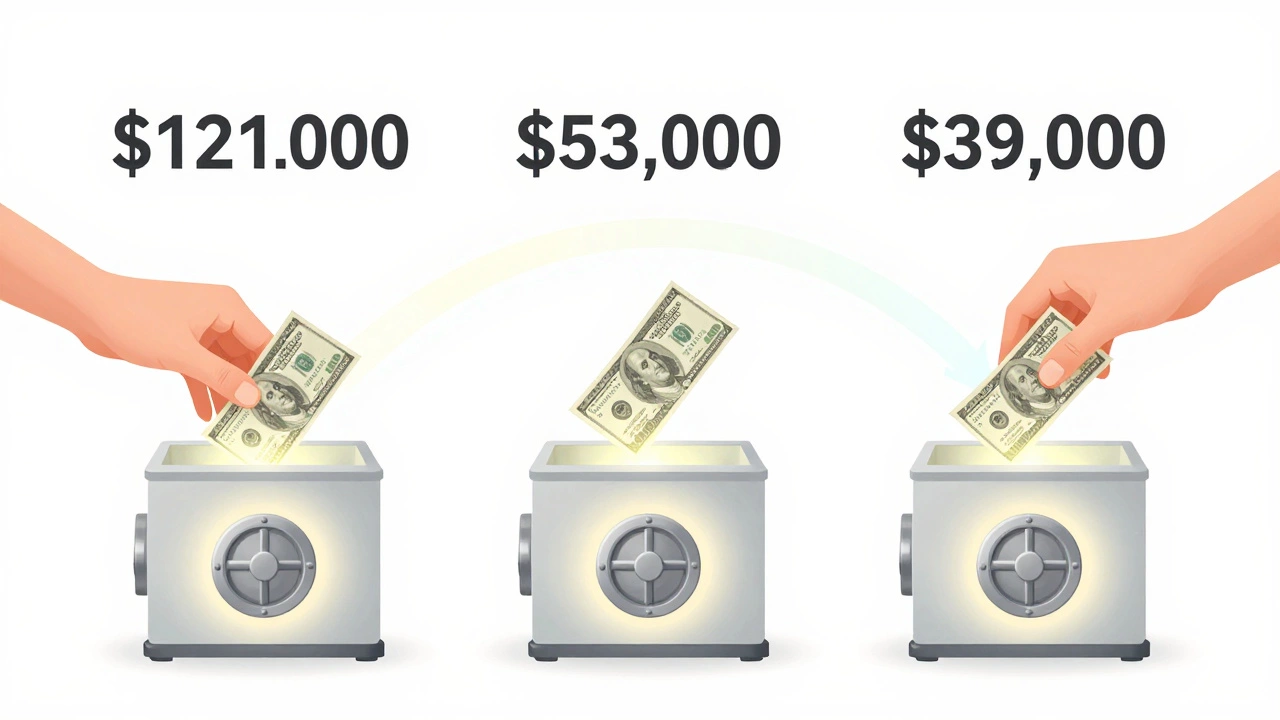
At 25, with 7% returns: $121,000.
At 35, with 7% returns: $53,000.
That’s not because you saved less. It’s because you lost 10 years of compounding. The earlier you start, the less you need to save to get the same result. That’s why people who begin young don’t have to work as hard later.
But if you’re 40 and haven’t started? Don’t panic. $100 a month still turns into $39,000 by age 65. That’s not retirement money, but it’s a solid foundation. And it’s better than nothing.

What if you increase your savings over time?
Most people get raises. Inflation pushes prices up. So why not increase your savings too? If you bump your monthly contribution by 3% each year-just enough to keep up with wage growth-you’ll end up with over $180,000 in 30 years at 7% returns.
Here’s how it works: Year 1: $100/month. Year 2: $103/month. Year 3: $106.09/month. By year 10, you’re saving $134 a month. By year 20, it’s $181. By year 30, you’re putting in $243 a month. Your total contributions jump to $64,000, but your ending balance? $183,000.
You didn’t double your income. You just kept pace with it. And that’s all it took to nearly double your final savings.
Real-life examples
Take Maria. She’s 27, makes $45,000 a year, and saves $100 a month from her paycheck. She doesn’t have a 401(k) yet, so she opens a Roth IRA at a discount brokerage and puts her money into a low-cost S&P 500 index fund. At 7% annual growth, she’ll have $121,000 by 57. That’s enough to cover a year’s worth of living expenses in retirement.
Now look at Jamal. He’s 32, makes $60,000, and saves $100 a month. He’s got a 401(k) but only contributes enough to get the company match. He doesn’t touch his extra $100. He keeps it in a checking account. By 62, he’ll have $38,000. That’s $83,000 less than Maria.
Same income. Same discipline. One made the choice to invest. The other just saved. The difference isn’t about effort. It’s about where the money went.
Where should you put your $100 a month?
Not in a piggy bank. Not in a regular savings account. Not under your mattress.
Here are three smart places:
- Roth IRA: You pay taxes now, but withdrawals in retirement are tax-free. Perfect if you expect to be in a higher tax bracket later. Max out $7,000 a year ($583/month) if you can. Even $100/month counts.
- Low-cost index fund: Vanguard, Fidelity, or Schwab offer S&P 500 funds with fees under 0.03%. These track the whole market. No stock picking needed. Just set up auto-investing.
- Employer-sponsored retirement plan: If your job offers a 401(k) or 403(b) with a match, contribute enough to get the full match first. That’s free money. Then add your $100 outside if you can.
Don’t overcomplicate it. Pick one. Set up automatic transfers. Forget about it. Check it once a year. That’s it.
Common mistakes people make
People think they need to save $500 or $1,000 a month to make a difference. That’s not true. They also think they need to time the market. They don’t. Or they wait for a ‘better time.’ There never is one.
Here are the top three mistakes:
- Waiting to start: You don’t need a bonus, a raise, or a windfall. Start now with $100. You can always increase it later.
- Keeping it in cash: Inflation eats away at cash. Over 30 years, $100 a month in a savings account loses nearly 40% of its buying power.
- Trying to pick stocks: Most people who try to beat the market lose. Index funds win by default.
Don’t be the person who says, ‘I wish I’d started sooner.’ Be the one who started with $100-and kept going.
What can you do with $120,000 in 30 years?
That’s not a luxury. That’s security. If you retire at 65 with $120,000 saved, and you withdraw 4% a year, that’s $4,800 a year-or $400 a month. That’s not enough to live on alone. But if you also get Social Security, it helps cover groceries, medicine, or a small vacation.
And if you saved $200 a month instead? You’d have $242,000. That’s $800 a month in retirement income. Suddenly, you’re not just surviving-you’re comfortable.
That’s the power of small, consistent steps. You don’t need to be rich. You just need to be steady.
Final thought: It’s not about how much you save. It’s about how long you let it grow.
Save $100 a month. Don’t check it every week. Don’t panic when the market dips. Don’t stop when life gets hard. Just keep going. Thirty years from now, you’ll look back and realize you didn’t need to be lucky. You just needed to be consistent.
That’s the real secret. Not magic. Not luck. Just time. And $100 a month.
How much will I have if I save $100 a month for 30 years at 7% interest?
You’ll have approximately $121,000. That includes $36,000 in your contributions and $85,000 in compound interest. This assumes monthly contributions and annual compounding at a 7% average return, which is close to the long-term historical average of the S&P 500.
Is $100 a month enough to save for retirement?
It’s a strong start, but not enough on its own for a full retirement. The average retiree needs about $45,000-$60,000 a year to live comfortably. $100 a month grows to $121,000 in 30 years, which can provide $400-$500 a month in retirement income. Combine it with Social Security, a pension, or other savings to reach your goal.
Should I save $100 a month in a savings account or invest it?
Invest it. A typical savings account earns less than 1% interest, so $100 a month for 30 years gives you only $38,000. Invest in a low-cost index fund through a Roth IRA or 401(k), and you’ll likely have over $120,000. The difference isn’t just in returns-it’s in preserving your buying power against inflation.
What happens if I stop saving after 15 years?
If you save $100 a month for 15 years and then stop, your money will still grow for another 15 years thanks to compounding. At 7% annual return, you’ll have about $57,000 at year 30. That’s still a solid amount-more than most people save in a lifetime. The key is letting your money keep working even after you stop contributing.
Can I save $100 a month if I’m on a tight budget?
Yes. Start by cutting one small recurring expense: a subscription you don’t use, daily coffee runs, or eating out twice a week. That’s often where $100 hides. Automate the transfer so it’s out of your account before you have a chance to spend it. Even $50 a month is better than nothing. Progress, not perfection, is what matters.