
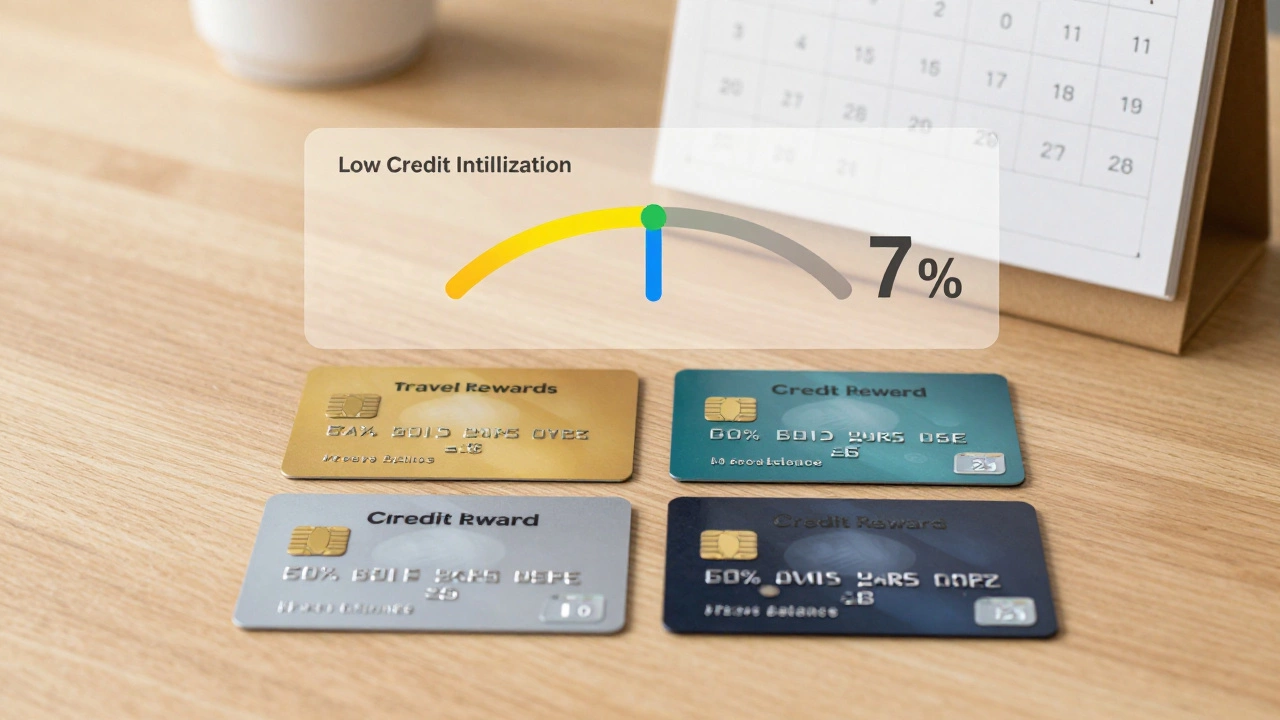
Credit Card Utilization Calculator
Your credit utilization ratio is one of the most important factors affecting your credit score (30% of your score). This tool calculates your utilization percentage based on your total credit limits and monthly spending.
The Federal Reserve found consumers with four or more cards had higher scores when utilization was below 10%. If you're carrying balances, interest costs can quickly add up.
Your credit utilization ratio is:
0.00%
Enter your numbers to see your utilization ratio and score impact.
Having four credit cards doesn’t automatically mean you’re in trouble. But it also doesn’t mean you’re doing everything right. The real question isn’t how many cards you have-it’s how you use them. People often assume more cards = more debt, or more cards = better credit. Neither is true. What actually matters is your spending habits, payment discipline, and how those cards affect your credit utilization ratio.
Why people get four credit cards
There are legit reasons why someone might carry four cards. Maybe one gives the best cash back on groceries, another offers travel points, a third has no annual fee, and the fourth is for emergencies. Some people use cards strategically: one for daily spending, one for gas, one for dining, and one for big purchases with 0% intro APR. It’s not about having them-it’s about using them with purpose.
For example, someone might use a Chase Sapphire Preferred for travel, a Capital One Quicksilver for everyday purchases, a Wells Fargo Reflect for a 0% balance transfer, and a store card for occasional discounts. Each card serves a different job. That’s not reckless-it’s smart.
How credit cards affect your credit score
Your credit score isn’t harmed by the number of cards alone. It’s affected by five things: payment history (35%), credit utilization (30%), length of credit history (15%), new credit (10%), and credit mix (10%).
Let’s break down what four cards could do:
- Positive impact: More total credit = lower utilization if you keep spending the same. Say you spend $1,500 a month. With one card at a $2,000 limit, your utilization is 75%. With four cards totaling $20,000 in limits, that same $1,500 spend is only 7.5%-way better for your score.
- Neutral impact: If you pay in full every month and never miss a payment, having four cards won’t hurt. The credit bureaus don’t punish you for having options.
- Risk: If you open all four cards in six months, that triggers hard inquiries and lowers your average account age. That can ding your score temporarily.
A 2023 study from the Federal Reserve found that consumers with four or more cards had, on average, higher credit scores than those with one or two-but only if they kept utilization below 10%. Those who maxed out even one card saw scores drop, no matter how many cards they had.
The hidden trap: too many cards = too much temptation
Here’s where things go sideways. People don’t always realize how easy it is to overspend when you have multiple cards. Each card feels like a separate budget. You think, “I’m only using this one for groceries,” then you use another for gas, another for Amazon, and suddenly you’re spending $4,000 a month instead of $2,000.
And if you carry balances? Interest adds up fast. A card with a 22% APR on a $1,000 balance costs you $220 a year. Do that on two cards, and you’re paying $440 just to carry debt. Four cards? You could be paying over $800 a year in interest without even realizing it.
Also, managing four cards means four due dates, four statements, four apps to check. Miss one payment, and your score drops. Late payments stay on your report for seven years. One slip can undo years of good habits.
When four cards make sense
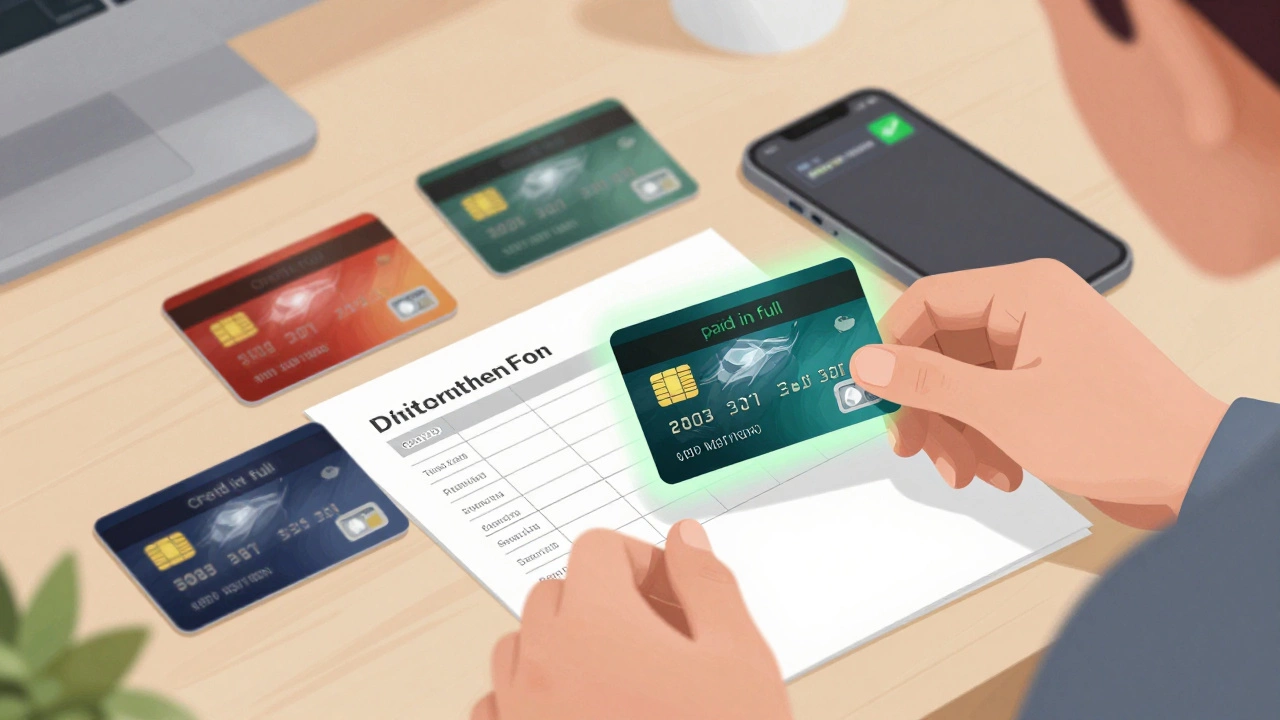
Four cards can be a tool-not a trap-if you meet these conditions:
- You pay off every card in full, every month.
- You keep total utilization under 10% across all cards.
- You have a system: calendar alerts, automatic payments, or a spreadsheet.
- You don’t apply for new cards often-no more than one every 6-12 months.
- You only keep cards that give you real value: rewards, benefits, or low rates.
For example, someone who travels twice a year and spends $30,000 annually might benefit from:
- A card with 3x points on travel
- A card with 5% cash back on groceries
- A 0% APR card for large, planned purchases
- A no-fee card for emergencies
That’s not overkill. That’s optimization.
When four cards are a red flag
These signs mean you’ve crossed the line:
- You carry a balance on more than one card.
- You’ve opened three cards in the last year.
- Your total credit limit is over $50,000 but your monthly spending is under $1,000.
- You’re using cards to pay for things you can’t afford.
- You forget due dates or pay late more than once.
If you’re doing any of those things, having four cards isn’t helping you-it’s hiding a deeper problem: overspending or poor budgeting. More cards won’t fix that. It’ll make it worse.

What to do if you have four cards
First, take stock. Log into each account. Write down:
- Annual fee
- APR
- Rewards rate
- Monthly spending on each
- Current balance
Then ask yourself:
- Which card am I using at least once a month?
- Which card gives me real value I couldn’t get elsewhere?
- Which card am I just keeping because I’m afraid to close it?
If a card has no fee and you’ve had it for years, keep it. Closing it could hurt your credit age and utilization. But if it charges $95 a year and you’ve used it once in two years? Close it. No guilt.
Don’t close multiple cards at once. Space it out. Close one every few months. That way, you avoid a sudden spike in utilization.
The sweet spot: 2-4 cards for most people
For 80% of people, 2-4 cards is the ideal range. Two for everyday use (one for rewards, one for low APR), one for emergencies, and one for big purchases if needed. That’s enough to optimize rewards without creating chaos.
Most people don’t need more. You don’t need a card for gas, groceries, dining, Amazon, and travel. You need one card that works well for most things, and maybe one bonus card for a category you spend heavily on.
The goal isn’t to collect cards. It’s to use them wisely. One card paid off monthly is better than four with balances. Two cards with perfect payment history and 5% utilization is better than four with 40% utilization.
Final thought: It’s not about the number
Having four credit cards isn’t too much-or too little. It’s what you do with them that counts. If you pay on time, keep balances low, and use them intentionally, four cards can help your credit. If you’re juggling payments, carrying debt, or opening new cards just to get bonuses, then even one is too many.
Ask yourself: Are your cards working for you-or are you working for them?
Is it bad to have four credit cards?
No, it’s not inherently bad. Having four credit cards can help your credit score if you pay them off in full each month and keep your total credit utilization below 10%. The problem comes when you carry balances, miss payments, or open too many cards in a short time. It’s not the number-it’s how you manage them.
Will closing a credit card hurt my credit score?
It can, but not always. Closing a card reduces your total available credit, which can raise your credit utilization ratio. It also shortens your average credit history if it’s one of your oldest accounts. If the card has no annual fee and you don’t use it, it’s usually better to keep it open. If it charges a fee and sits unused, closing it is fine-just close one at a time and pay down other balances first.
How many credit cards is too many?
There’s no fixed number, but if you’re applying for new cards every few months, carrying balances, or forgetting due dates, you likely have too many. For most people, 3-4 cards is enough. More than that only makes sense if you have a clear, disciplined system for rewards, spending, and payments.
Do credit card companies care how many cards I have?
Yes-but not in the way you think. They don’t care if you have four cards. They care if you’re using them responsibly. If you pay on time, keep low balances, and don’t max out, they’ll keep offering you more credit. If you’re close to your limits or miss payments, they’ll cut your limits or deny future applications. Your behavior matters more than your count.
Should I get a fifth credit card?
Only if you have a specific reason. Maybe you need a card with a better rewards rate for a category you spend heavily on, or you want to transfer a balance to a 0% APR card. Don’t get it just because you got approved. If you’re already managing four cards well, adding a fifth increases your risk of overspending or missing payments. Wait until you’re sure you need it-and that you can handle it.