

Savings vs. Investing Opportunity Cost Calculator
Projected Results
Values shown are nominal future values.
Imagine you put $10,000 into a standard savings account five years ago. Today, that money is still there-plus a few hundred dollars in interest. But here’s the kicker: that $10,000 doesn’t buy what it used to. Groceries cost more. Rent is higher. Even your morning coffee has crept up in price. This isn’t just bad luck; it’s the silent thief known as inflation. If you’re wondering whether leaving money in a savings account is actually hurting your financial future, you’re asking the right question. The answer isn’t a simple yes or no-it depends on what that money is for, how much interest you’re earning, and where else it could be working harder for you.
Many people treat their savings account like a digital piggy bank: safe, accessible, and out of mind. But in today’s economic landscape, "safe" can sometimes mean "stagnant." To figure out if your cash is sitting idle too long, we need to look at the real return on your money, not just the headline interest rate. Let’s break down when keeping cash in savings makes sense, when it starts costing you, and how to move your money around without losing sleep over security.
The Math Behind the Myth: Why Your Cash Might Be Losing Value
To understand if leaving money in a savings account is "bad," you first have to understand the difference between nominal returns and real returns. Nominal return is the percentage interest your bank pays you. Real return is what’s left after you subtract inflation. If your savings account pays 4% interest but inflation runs at 3%, your real return is only 1%. That might sound positive, but consider this: if inflation spikes to 5% while your rate stays at 4%, you are technically losing purchasing power every single day. You are paying a hidden tax simply by holding onto cash.
This phenomenon is often called "cash drag." In investing terms, cash drag refers to the portion of your portfolio held in low-yielding assets that drags down overall performance. For example, if you have $100,000 invested across stocks and bonds averaging an 8% annual return, but you keep $20,000 in a savings account earning 1%, that $20,000 is pulling your average return down significantly. Over ten years, that difference compounds into thousands of lost dollars. It’s not that savings accounts are evil; it’s that they are designed for preservation, not growth. Using them for wealth building is like using a bicycle to cross the ocean-you’ll get there eventually, but you’ll miss the boat on efficiency.
However, context matters immensely. Not all cash is meant to grow aggressively. Some cash needs to stay liquid and safe. The key is distinguishing between money you need soon and money you won’t touch for decades. Mixing these two goals in one account is a common mistake that leads to either panic selling during market dips or missing out on investment gains during bull markets.
When Keeping Cash in Savings Is Actually Smart
There are specific scenarios where leaving money in a savings account is not just acceptable, but financially prudent. The primary reason is liquidity. Liquidity means how quickly you can access your funds without penalty. Savings accounts offer immediate access, which is crucial for unexpected expenses. If your car breaks down or you face a medical bill, you don’t want to be forced to sell stocks at a loss or pay early withdrawal penalties on a certificate of deposit (CD).
The most critical use case for a savings account is the emergency fund. Financial experts generally recommend keeping three to six months’ worth of living expenses in a highly liquid, low-risk account. This buffer protects you from going into debt when life throws a curveball. Without this cushion, a minor setback can spiral into credit card debt, which carries interest rates often exceeding 20%. In this scenario, the modest interest earned in a savings account is irrelevant compared to the disaster prevention it provides. Here, safety and accessibility outweigh potential growth.
Another valid reason to hold cash is for short-term goals. If you are saving for a house down payment, a wedding, or a new car within the next one to two years, the stock market is likely too volatile for your needs. Markets can drop 10-20% in a matter of months. If your goal date is fixed, you cannot afford that timing risk. A savings account guarantees your principal will remain intact. In this window, preserving capital is more important than maximizing yield. You are trading potential upside for certainty, which is a rational choice when time horizons are short.
The High-Yield Advantage: Not All Savings Accounts Are Created Equal
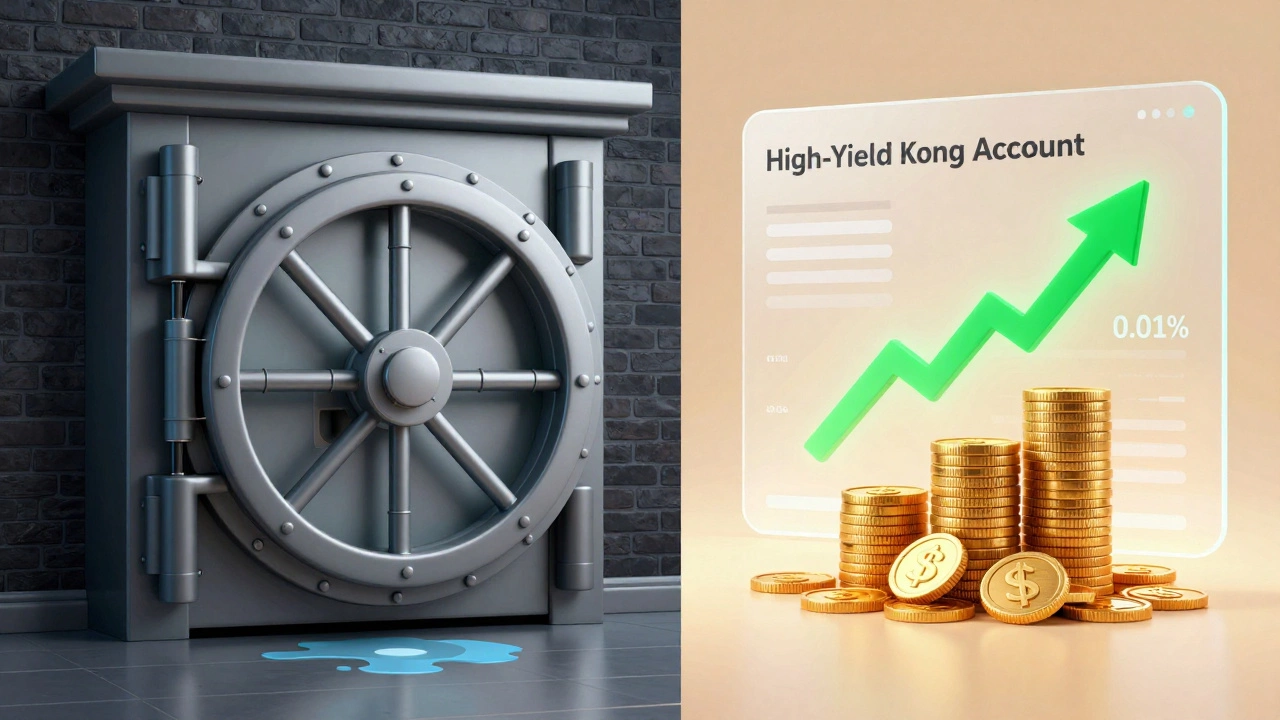
If you decide that some of your money should stay in savings, you must ensure you are not leaving free money on the table. Traditional brick-and-mortar banks often pay negligible interest rates-sometimes less than 0.01%-because they have higher overhead costs. Online banks, however, operate with lower expenses and can pass those savings on to customers in the form of higher yields. These are known as High-Yield Savings Accounts (HYSAs).
| Feature | Standard Bank Savings | High-Yield Savings (HYSA) |
|---|---|---|
| Annual Percentage Yield (APY) | 0.01% - 0.5% | 4.0% - 5.5% |
| Minimum Balance Requirements | Often none, but fees apply if low | Varies, often $0-$1,000 |
| Accessibility | Branch visits, ATM, transfers | Online transfer, mobile app |
| Fees | Maintenance fees common | Usually fee-free |
The difference in APY is stark. On a $10,000 balance, a standard account might earn $0.50 a year, while a HYSA could earn $400 to $550. That’s nearly $1,000 in extra income over two years for doing exactly the same thing: leaving the money alone. Before judging whether keeping cash is "bad," check if you are at least using a HYSA. If you are accepting 0.01% because you’re lazy or afraid of online banking, that is indeed bad financial management. Moving your money to a federally insured online institution takes minutes and requires zero additional risk.
It is also worth noting that HYSAs are not static. Interest rates fluctuate with the broader economy, particularly influenced by central bank policies. When rates rise, HYSA yields typically follow. When rates fall, they drop too. This variability means you should periodically review your accounts. If your current HYSA drops below the market average, switching providers is easy. Loyalty to a bank that underpays you is a costly habit.
Opportunity Cost: What Could Your Money Be Doing Instead?
The real danger of leaving money in a savings account arises when that money is earmarked for long-term goals, such as retirement or wealth accumulation. Here, the concept of opportunity cost comes into play. Opportunity cost is the potential gain you miss out on by choosing one alternative over another. By keeping $50,000 in a savings account earning 4%, you are implicitly deciding not to invest it elsewhere.
Historically, broad stock market indices like the S&P 500 have returned an average of 7-10% annually before inflation, and about 5-7% after inflation, over long periods. While past performance does not guarantee future results, the gap between 4% (savings) and 7% (market average) is significant. Let’s look at a concrete example. If you invest $50,000 for 20 years at 4%, it grows to approximately $110,000. At 7%, it grows to roughly $190,000. That $80,000 difference represents the cost of playing it too safe. For young investors or those with distant goals, leaving large sums in savings is essentially donating wealth to inflation and missed compounding opportunities.
However, this comparison assumes you can handle volatility. The stock market goes up and down. In any given year, it can lose value. A savings account never loses principal (assuming FDIC/NCUA insurance). The trade-off is clear: higher potential returns come with higher risk. If the sight of your portfolio dropping 15% keeps you awake at night, then the psychological cost of investing may outweigh the financial benefit. In that case, sticking to savings is a valid personal preference, even if it’s mathematically suboptimal. Finance is not just about numbers; it’s about behavior. If you panic-sell during a crash, you lock in losses. A savings account prevents emotional decision-making.

Strategic Allocation: How to Balance Safety and Growth
Rather than viewing savings accounts and investments as enemies, think of them as teammates in different positions. A balanced financial strategy involves allocating cash based on time horizon and purpose. This approach minimizes regret and maximizes outcomes.
- Emergency Fund: Keep 3-6 months of expenses in a High-Yield Savings Account. Do not touch this unless necessary. Its job is protection, not profit.
- Short-Term Goals (1-3 years): Use savings accounts or CDs for money needed for down payments, vacations, or major purchases. Prioritize capital preservation.
- Medium-Term Goals (3-7 years): Consider a mix of bonds and conservative stocks. The timeline allows you to recover from minor market dips while earning more than savings accounts.
- Long-Term Goals (7+ years): Aggressively invest in diversified portfolios (stocks, ETFs, index funds). Time smooths out volatility, allowing compound interest to work its magic.
This segmentation ensures that you are not exposing short-term needs to market risk, nor are you stifling long-term wealth with low-yield cash. Review this allocation annually. As you age, your emergency fund needs may change, and your investment horizon may shorten. Adjust accordingly. For instance, if you plan to retire in five years, start shifting more money from stocks back into safer assets like bonds and savings to protect your nest egg from a late-stage market crash.
Tax implications also play a role. Interest earned in traditional savings accounts is taxed as ordinary income, which can be higher than the long-term capital gains tax rate applied to investments held for over a year. However, tax-advantaged accounts like IRAs or 401(k)s can mitigate this. If your savings account is inside a Roth IRA, the interest grows tax-free. This changes the calculus slightly, making savings accounts more attractive within those specific wrappers, though they still lag behind equities in growth potential.
Common Pitfalls to Avoid
Even with a solid strategy, behavioral biases can lead you astray. One common trap is "safety bias," where investors become so risk-averse after a market downturn that they park all their money in savings indefinitely. This freezes wealth creation. Another pitfall is ignoring fees. Some savings accounts charge monthly maintenance fees if you don’t meet minimum balance requirements. These fees can eat up more interest than you earn, resulting in a negative return. Always read the fine print.
Additionally, do not confuse convenience with optimization. Just because your paycheck deposits into your checking account and auto-transfers to a linked savings account doesn’t mean that savings account is the best place for your money. Automate transfers to a dedicated HYSA instead. Set up automatic contributions to your investment accounts as well. Automation removes the friction of decision-making and ensures you are consistently executing your strategy.
Finally, beware of predatory lending disguised as savings products. Some institutions offer complex certificates of deposit or money market accounts with hidden clauses or early withdrawal penalties that negate their benefits. Stick to simple, transparent products. If you can’t explain how the account works in plain English, it’s probably too complicated for your core savings strategy.
Is it better to keep money in a savings account or invest it?
It depends on your time horizon. For money you need within 1-3 years, a savings account is safer and preserves capital. For money you won’t need for 5+ years, investing in stocks or ETFs historically offers higher returns, compensating for inflation and generating wealth. A balanced approach uses both: savings for emergencies and short-term goals, investments for long-term growth.
How much money should I keep in my savings account?
Financial experts recommend keeping 3 to 6 months of essential living expenses in a high-yield savings account as an emergency fund. This covers rent, utilities, food, and insurance. Once this fund is established, excess cash should ideally be moved to investment vehicles for long-term growth, unless you have a specific short-term goal like buying a home.
Does inflation really make savings accounts worthless?
Not worthless, but their purchasing power can erode if the interest rate is lower than the inflation rate. For example, if inflation is 5% and your savings account pays 3%, you are losing 2% of your buying power annually. High-yield savings accounts often mitigate this by offering rates closer to or above inflation, but they rarely beat it significantly over the long term compared to equities.
Are high-yield savings accounts safe?
Yes, provided they are insured by the FDIC (for banks) or NCUA (for credit unions) in the United States. This insurance covers up to $250,000 per depositor, per institution. Always verify the insurance status of your online bank before depositing funds. The risk of losing your principal in an insured HYSA is virtually non-existent, similar to traditional banks.
Should I move my emergency fund to the stock market?
No. Emergency funds require immediate liquidity and stability. The stock market is volatile and can drop sharply when you need money most. Selling stocks during a downturn locks in losses. An emergency fund’s purpose is to prevent debt, not to generate high returns. Keep it in a high-yield savings account or money market fund for safety and quick access.