
Credit Card Utilization Calculator
Your Credit Cards
How This Works
When you close a credit card, your total available credit decreases, which increases your credit utilization ratio. This can lower your credit score.
Credit Utilization = (Total Balance / Total Credit Limit) × 100
Example: If you have $10,000 credit limit with $2,000 balance, your utilization is 20%.
After closing a card with $5,000 limit (zero balance), your new utilization becomes: $2,000 / $5,000 = 40%.
Results
Current Utilization: 0%
After Closing: 0%
Change: 0%
It’s a common question: if you’ve paid off your credit card and aren’t using it anymore, should you close it or just leave it open with a zero balance? Many people assume closing the account is the cleanest move - no temptation to spend, no annual fees, no risk of fraud. But what most don’t realize is that closing a credit card can actually hurt your credit score more than keeping it open - even if you never use it again.
How Credit Scores Really Work
Your credit score isn’t just about how much you owe. It’s built on five main pieces: payment history (35%), credit utilization (30%), length of credit history (15%), new credit (10%), and credit mix (10%). When you close a credit card, you’re not just removing a card - you’re changing how these factors play out.
Take credit utilization, for example. That’s the percentage of your total available credit you’re using. If you have two cards, each with a $5,000 limit, and you owe $1,000 on one, your utilization is 10% ($1,000 owed / $10,000 total limit). Now, if you close the second card, your total limit drops to $5,000. Suddenly, that same $1,000 debt jumps to 20% utilization - and every point above 30% starts to drag your score down.
Why Length of Credit History Matters
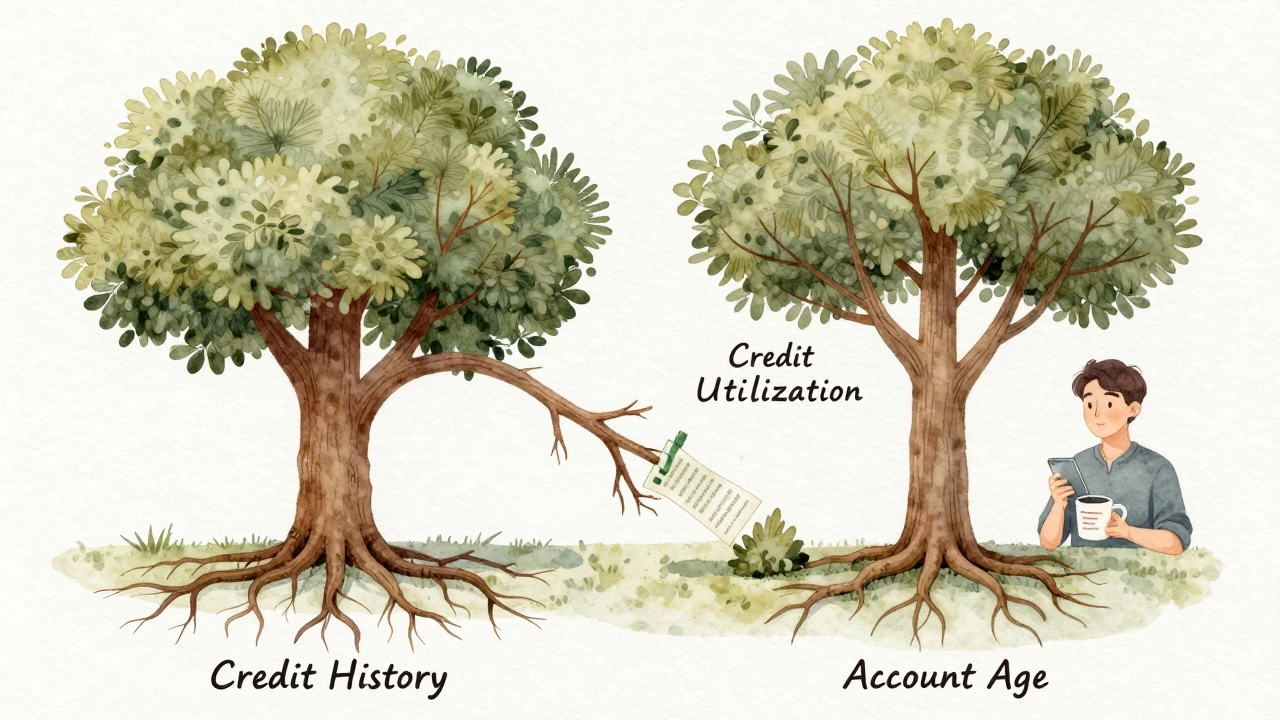
Your credit history doesn’t disappear when you close a card. The account still shows up on your report for up to 10 years after closure. But here’s the catch: the age of your oldest account and the average age of all your accounts are calculated using open accounts only. Closing an older card can shorten your average credit history - and that can cost you points.
In New Zealand, where credit histories are typically shorter than in the U.S., even a single older account can make a big difference. If you opened your first credit card at 22 and now you’re 35, that 13-year history is a strong signal to lenders. Shutting it down early could make you look less stable - even if you’ve never missed a payment.
The Real Risk of Closing: Credit Utilization Spike
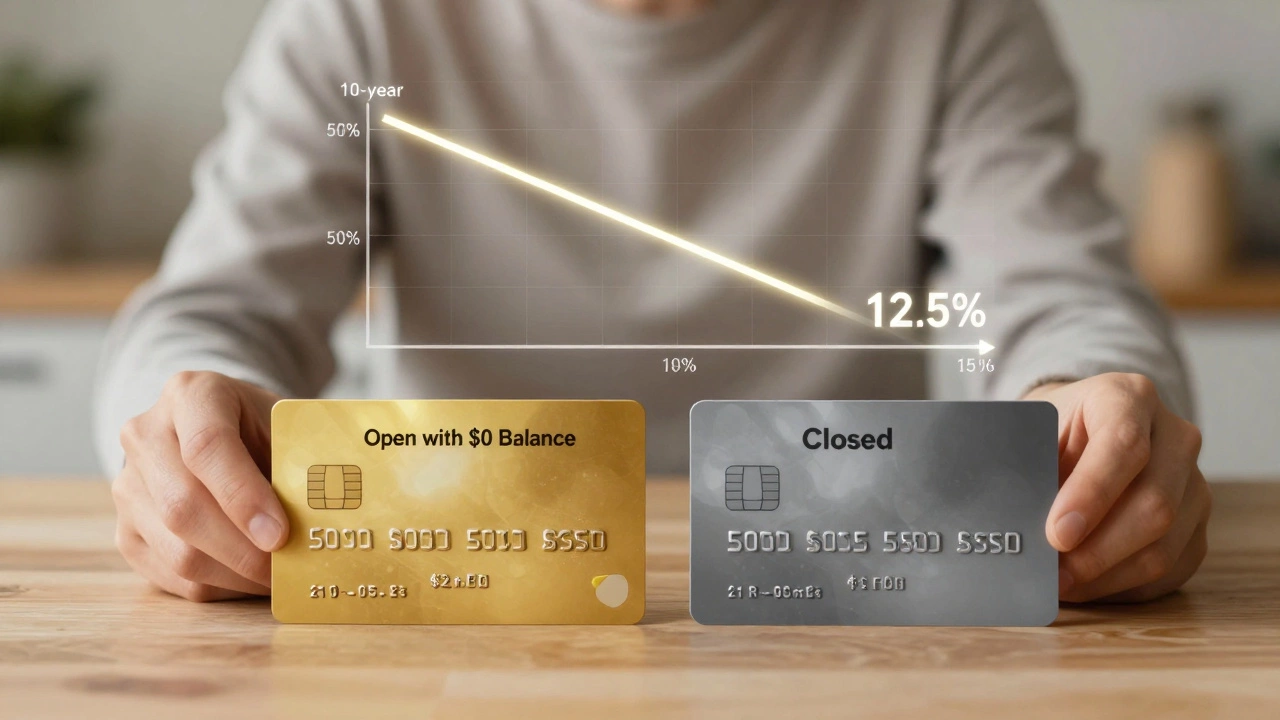
Let’s say you have a card with a $10,000 limit that you never use. You owe $0. Your utilization is 0%. Sounds perfect, right? But if you close it, and you have another card with a $3,000 limit and a $1,500 balance, your utilization jumps from 12.5% to 50%. That’s a massive swing.
One study from the Federal Reserve Bank of Philadelphia tracked over 20,000 credit card closures and found that people who closed cards saw their scores drop an average of 12 points within six months - even if they had no other debt. For someone with a score around 700, that’s enough to push them out of the ‘excellent’ credit tier and into ‘good’. That could mean higher interest rates on future loans, or even denials.
When Closing Might Make Sense
There are real cases where closing a card is the smarter move:
- You’re paying an annual fee and won’t use the card enough to justify it
- The card has a high interest rate and you’re worried about accidental spending
- You’ve been targeted by fraud or identity theft linked to that account
- You’re struggling with impulse spending and removing temptation helps you stay on track
If you’re closing a card because you’re trying to break a spending habit, that’s a win - even if your score dips a little. Financial health isn’t just about numbers on a report. It’s about behavior. If closing the card helps you avoid debt, the short-term score hit might be worth it.
What to Do Instead of Closing
Before you cancel, try these alternatives:
- Call your issuer and ask if you can downgrade to a no-fee version of the same card. Many banks will let you switch without closing the account.
- Use the card for one small purchase every few months - like your coffee subscription or Netflix - and pay it off immediately. That keeps it active without risking debt.
- Set up autopay for a recurring bill (like your phone or internet) on the card. Just make sure you have enough in your account to cover it.
These small actions keep the account open, maintain your credit limit, and preserve your credit history. You get the benefits without the risk.
What Happens to Your Credit Report After Closing
Even after you close a card, it doesn’t vanish from your report. Closed accounts with zero balances stay on your credit file for up to 10 years. But here’s what changes:
- The account stops contributing to your credit utilization ratio
- It no longer counts toward the average age of your accounts
- It becomes less useful as proof of responsible credit management
If you have multiple other cards, the impact might be small. But if this was your only card, or your oldest one, the damage can be noticeable.

Is a Zero Balance Really Safe?
Some people worry that leaving a card open with zero balance means the issuer might close it anyway. That’s true - issuers do close inactive accounts. But it usually takes 12 to 24 months of zero activity. A single small purchase every six months is enough to keep it alive.
Also, having unused credit doesn’t hurt you. Lenders don’t penalize you for having too much available credit. In fact, it works in your favor. It shows you’re trusted by other lenders - and that you manage credit responsibly.
Real-World Example: A Kiwi’s Story
In Auckland, a 31-year-old teacher paid off her $8,000 credit card balance after a year of careful budgeting. She wanted to close it to avoid temptation. Her credit score was 760. After closing the card - her oldest one - her score dropped to 710 within four months. She applied for a car loan a few weeks later and was offered a 9.5% interest rate instead of 7.2%. She reopened the account, made one small purchase, and set up autopay. Within six months, her score climbed back to 755.
She didn’t spend a cent more. She just kept the account open.
Final Advice: Don’t Close Unless You Have To
If your card has no fee and you’re not tempted to spend, leave it open. Keep the credit limit. Keep the history. Keep the score. It’s not about using the card - it’s about keeping the system working for you.
Think of your credit history like a muscle. If you don’t use it, it weakens. But if you use it lightly and consistently, it gets stronger. A zero balance isn’t a problem - it’s a sign of good habits. Don’t throw away that advantage.
Will closing a credit card with zero balance hurt my credit score?
Yes, it can. Closing a card reduces your total available credit, which increases your credit utilization ratio. It can also shorten your average credit history. Both of these can lower your score - sometimes by 10 to 20 points or more, depending on your overall credit profile.
Is it better to have zero balance on all credit cards?
Having a zero balance on all cards is generally good - as long as you don’t close the accounts. A zero balance means you’re not paying interest, and it keeps your credit utilization low. The key is to keep the accounts open so they continue helping your credit history and limit.
How long does a closed credit card stay on my credit report?
A closed credit card with a positive payment history stays on your report for up to 10 years. Accounts with negative history (like late payments) stay for 7 years. But once closed, the account no longer affects your credit utilization or average account age.
Can a credit card company close my account if I don’t use it?
Yes. Most issuers will close inactive accounts after 12 to 24 months of no activity. To prevent this, make a small purchase every six months and pay it off right away. Even a $5 coffee purchase keeps the account active.
Should I close a credit card if I’m trying to get out of debt?
If closing the card helps you avoid future spending, it might be worth the short-term hit to your credit score. Your long-term financial health matters more than a number. But consider downgrading to a no-fee card or using it for one small autopay bill instead - that way, you keep the credit history without the risk.