

70-15-15 Budget Calculator
Your budget breakdown
Tip: If your rent is high, your living expenses may exceed 70%. In that case, you might need to adjust your percentages (e.g., 75%/15%/10%) but still prioritize saving and investing.
Investment Tip: Your 15% investment can grow significantly over time. For example, $750/month with 5% annual return becomes over $230,000 in 10 years!
Most people think budgeting means tracking every coffee, every bus fare, every snack. But what if you could manage your money without the stress? Enter the 70-15-15 budget - a straightforward system that works for real life, not spreadsheets. It doesn’t ask you to cut out fun. It just asks you to be clear about where your money goes. And it’s not some fancy Wall Street trick. It’s the same method used by thousands of families in Auckland, Wellington, and beyond who want to get ahead without going crazy.
What does 70-15-15 actually mean?
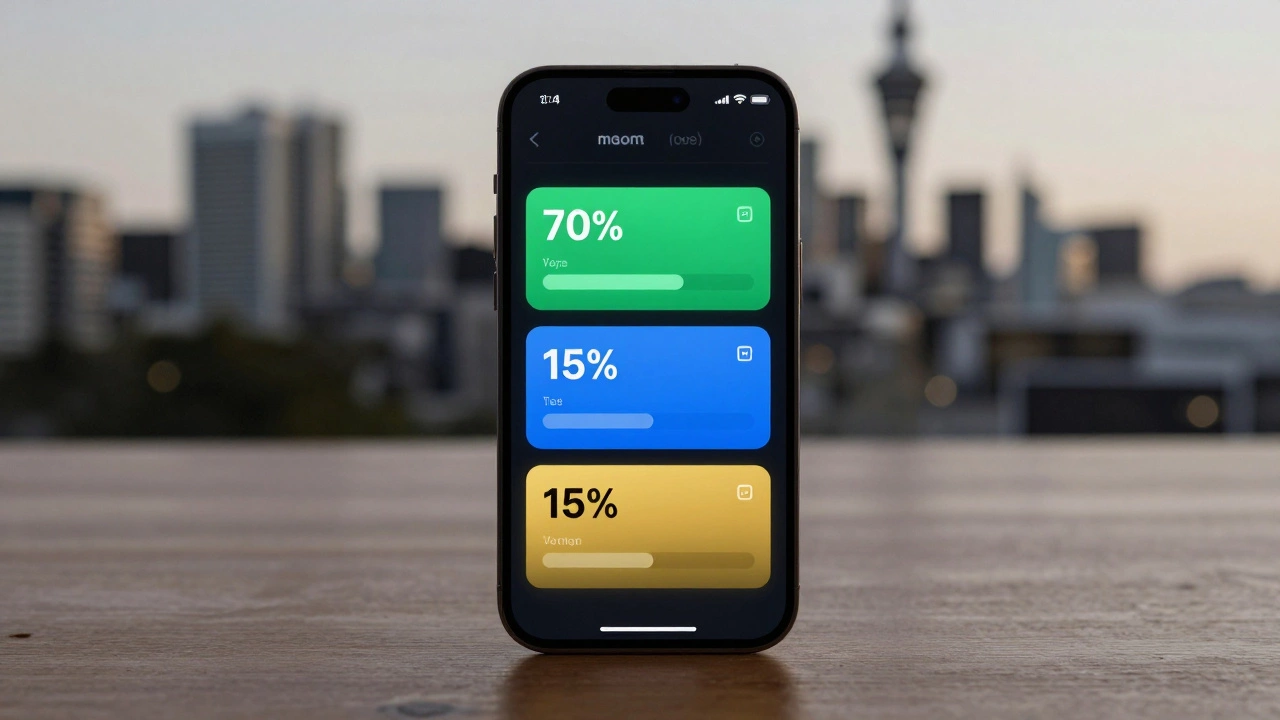
The 70-15-15 budget splits your take-home pay into three buckets:
- 70% for living expenses - rent, groceries, bills, transport, phone, and yes, even dining out or Netflix.
- 15% for saving - emergency fund, short-term goals like a new laptop or vacation, or putting money aside for a car.
- 15% for investing - stocks, KiwiSaver, index funds, or even starting a side business.
That’s it. No complex formulas. No guilt trips. Just three clear rules.
Let’s say you earn $5,000 a month after tax. Here’s how it breaks down:
- $3,500 - living expenses
- $750 - saving
- $750 - investing
Notice something? You’re not saving pennies. You’re putting $1,500 a month toward your future. That’s $18,000 a year. Over ten years, with even a modest 5% return, that’s over $230,000 - just from this one rule.
Why this works better than other budgeting methods
Many people try the 50/30/20 rule - 50% needs, 30% wants, 20% savings. But here’s the problem: what if your rent is 40% of your income? What if you’re trying to pay off debt? Suddenly, 20% savings feels impossible.
The 70-15-15 budget doesn’t care if your rent is high. It doesn’t label your spending as ‘needs’ or ‘wants.’ It just says: spend 70% on life, save 15%, invest 15%. It’s flexible by design.
And unlike apps that track every cent, this method lets you live. You can go out for dinner, buy new shoes, or take a weekend trip - as long as your total spending doesn’t blow past 70%. You’re not policing yourself. You’re setting boundaries.
How to start the 70-15-15 budget today
You don’t need to wait for payday. Here’s how to jump in right now:
- Calculate your take-home pay. This is your income after tax, KiwiSaver deductions, and student loan repayments. Don’t use your gross salary.
- Set up three bank accounts. One for spending, one for saving, one for investing. You can use separate accounts at your bank, or use a digital wallet like Xero or PocketBook to track them.
- Automate transfers. On payday, move 70% to your spending account, 15% to savings, 15% to investing. Do this automatically. No thinking required.
- Track your spending for 30 days. Just watch how much you’re using from your 70% bucket. If you’re over, adjust next month. If you’re under, you can move extra to savings or investing.
Most people find that after two months, they naturally spend less on impulse buys. Why? Because they see the money leaving their spending account - and they don’t want to run out before payday.
What if your rent is more than 70%?
This is the most common objection. If you’re paying $2,500 rent on a $3,500 take-home pay, you’re already at 71%. What now?
First, don’t panic. The 70-15-15 rule isn’t a law - it’s a guideline. The goal is to get as close as you can. If rent is eating up 75%, then adjust the other buckets slightly:
- 75% living
- 15% saving
- 10% investing
That’s still better than spending 90% and saving nothing. And here’s the key: you’re still investing 10%. That’s more than 80% of New Zealanders.
Long-term, look for ways to reduce housing costs - move to a cheaper area, get a flatmate, or consider house-sitting. But don’t wait for the perfect situation to start saving. Start now, even if it’s imperfect.
Where should you invest your 15%?
Investing doesn’t mean picking individual stocks or trading crypto. For most people, it means putting money into low-cost, long-term options.
Here are three simple choices in New Zealand:
- KiwiSaver - If you’re not in KiwiSaver, you’re leaving free money on the table. The government adds 50 cents for every dollar you put in, up to $521 a year. That’s a guaranteed 100% return on the first $1,043 you save.
- Index funds - Funds like Smartshares NZX 50 or Vanguard Global Shares give you exposure to hundreds of companies with one purchase. Fees are under 0.2% a year.
- Property crowdfunding - Platforms like BrickX or PropertyGuru let you invest from $500 in residential or commercial property. It’s not as liquid as shares, but it’s a real way to build wealth without buying a whole house.
Don’t overthink it. Pick one. Start small. Let it grow.
What about debt?
If you have credit card debt, personal loans, or student loans, the 70-15-15 budget still works - but you tweak it.
Use this version:
- 70% living
- 15% paying off high-interest debt
- 15% saving/investing
Once your high-interest debt (anything over 8%) is gone, shift that 15% back to investing. Debt repayment becomes your temporary investing phase.
For example, if you’re paying $300 a month on a credit card at 18% interest, that’s $54 a month in interest alone. Paying it off fast is the best return you’ll ever get.
Real people, real results
Jamie, 32, works in retail in Hamilton. She made $4,200 a month after tax. She was spending $3,800 - and saving nothing. She started the 70-15-15 budget in March 2025.
First month: she overspent by $200. Second month: she cut her takeaways in half and saved $150. By month four, she had $1,200 in savings and $1,200 in KiwiSaver. By December 2025, she had $7,500 saved and $7,500 invested. She’s on track to buy her first car next year - without taking on more debt.
Mark and Lisa, 45, both teachers in Tauranga. They were putting $500 a month into KiwiSaver but had no emergency fund. They switched to 70-15-15. Now they have $15,000 saved for a kitchen renovation - and their KiwiSaver balance grew by $22,000 in 18 months.
These aren’t millionaires. They’re regular people who just decided to stop guessing.
Common mistakes - and how to fix them
People mess up this budget in predictable ways:
- They forget to use take-home pay. Always use your net income. Gross pay includes money you never see.
- They combine savings and investing. Don’t. Savings is for short-term goals (under 5 years). Investing is for long-term growth. Mixing them leads to panic selling.
- They skip the automation. If you have to move money manually, you’ll forget. Set up auto-transfers on payday.
- They think it’s too rigid. It’s not. If you get a bonus, put 70% into spending (enjoy it!), 15% to savings, 15% to investing. You’re still following the rule.
The biggest mistake? Waiting until you "have more money" to start. You don’t need more money. You just need a plan.
Why this budget lasts
Most budgeting systems fail because they feel like punishment. The 70-15-15 budget doesn’t punish you. It empowers you.
You get to spend 70% - no guilt. You get to save 15% - peace of mind. You get to invest 15% - freedom for your future.
It’s not about being perfect. It’s about being consistent. And in the end, consistency beats perfection every time.