

Golden Rule Budget Calculator
Apply the proven 50/30/20 rule to your take-home pay. This tool calculates how much you should allocate to needs (50%), wants (30%), and savings/debt (20%) based on your income.
Your Budget Allocation
Note: Needs include essentials like housing, utilities, and groceries. Wants are discretionary spending. The savings/debt category should prioritize emergency funds and debt repayment. Adjust based on your personal circumstances.
If you’ve ever felt like your paycheck disappears before the end of the month-no matter how hard you try-you’re not broken. You just haven’t found a system that actually works. The golden rule budgeting isn’t some fancy Wall Street trick. It’s a simple, proven way to take control of your money without tracking every coffee or grocery receipt. And yes, it works whether you make $30,000 or $80,000 a year.
What exactly is the golden rule budgeting?
The golden rule budgeting, also known as the 50/30/20 rule, breaks your take-home pay into three buckets:
- 50% for needs-things you absolutely must pay to survive and stay functional.
- 30% for wants-everything else that makes life enjoyable but isn’t essential.
- 20% for savings and debt repayment-building security and freedom for the future.
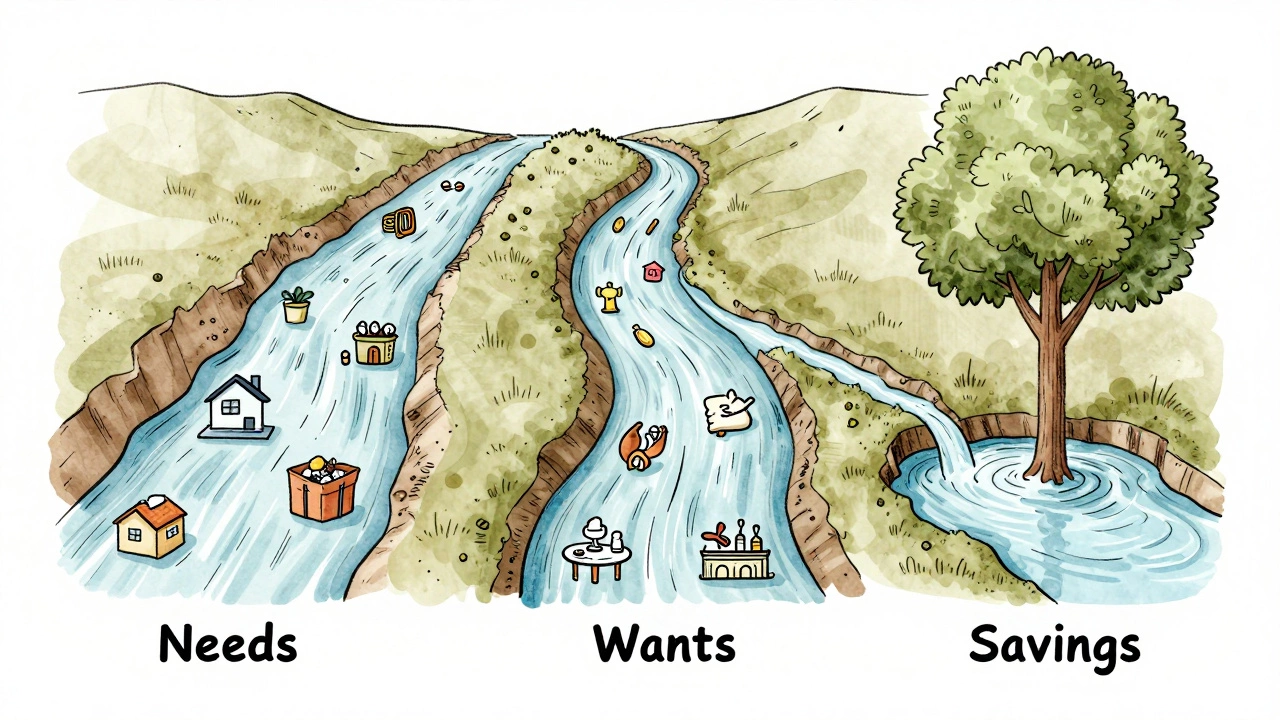
This isn’t a suggestion. It’s a structural rule. Think of it like setting up your income like a river: half flows to keep the lights on, a third flows to let you enjoy the ride, and the rest gets stored in a reservoir for storms ahead.
It was popularized by Senator Elizabeth Warren and her daughter Amelia Warren Tyagi in their 2005 book All Your Worth. Since then, it’s been used by millions-from students in Dunedin to nurses in Christchurch-because it’s simple enough to remember while you’re rushing out the door, but powerful enough to change your financial life.
What counts as a ‘need’?
This is where most people get tripped up. A ‘need’ isn’t what you wish you had. It’s what you can’t live without.
True needs include:
- Housing (rent or mortgage)
- Utilities (electricity, water, internet if you work from home)
- Groceries (not dining out)
- Basic transportation (fuel, public transit, car payments if you need a car to work)
- Health insurance and essential medical costs
- Minimum debt payments (credit cards, student loans)
- Childcare if you’re working
Here’s what’s not a need:
- Streaming subscriptions (Netflix, Disney+)
- Brand-name clothes when generic ones work
- Upgrading your phone every year
- Expensive gym memberships (a park or home workout is free)
- Weekly takeaways or coffee shop runs
One Auckland mum, Sarah, told me she thought her $1,200 rent and $300 car payment were her only needs. But when she added her $180 phone bill, $120 for groceries, $70 for insurance, and $100 for gas, she realized her ‘needs’ were already $1,970-over half her $3,800 take-home pay. She didn’t realize how close she was to breaking the rule. That’s the moment she started saving.
What counts as a ‘want’?
This is the fun part. Wants are what make life worth living. But they’re also where most budgets go off the rails.
Wants include:
- Dining out
- Hobbies (painting, guitar lessons, crafting)
- Travel and weekend getaways
- Designer clothes, new shoes, gadgets
- Subscription services you don’t use
- Gifts beyond basic birthdays
- Alcohol, smoking, or other personal indulgences
Here’s the catch: your wants aren’t bad. They’re human. The problem isn’t wanting a nice dinner or a new pair of sneakers. It’s letting wants eat into your future.
One guy I know, Mark, spent $900 a month on takeaways, alcohol, and new video games. He thought he was just ‘treating himself.’ But when he looked at his savings account-$270 total-he realized he was spending more on pizza than he was putting toward his emergency fund. He cut his takeaways to $300 a month. That $600 difference went straight into his savings. Within a year, he had $7,200 saved. No raise. No windfall. Just a shift in priorities.
Why 20% for savings and debt?
This is the most powerful part. You’re not saving ‘what’s left.’ You’re paying yourself first.
That 20% covers:
- Emergency fund (aim for 3-6 months of living expenses)
- Retirement contributions (KiwiSaver, superannuation, or other plans)
- Extra payments on debt (beyond the minimum)
- Saving for big goals (car, house deposit, trip)
If you’re carrying debt, this is your lifeline. Paying only the minimum on a credit card with 20% interest means you’re digging a deeper hole. The golden rule forces you to attack that debt head-on.
Take Lisa, a teacher in Tauranga. She had $8,000 in credit card debt at 22% interest. Her minimum payment was $200. She was barely keeping up. Under the 50/30/20 rule, she allocated $500 a month to debt and savings. She paid $300 extra toward her credit card. In 18 months, she was debt-free. She didn’t win the lottery. She just stopped letting her wants steal from her future.
What if your needs are more than 50%?
This happens. A lot. Especially if you live in expensive cities like Auckland, Wellington, or Queenstown.
If your needs are 60% or 70%, you don’t fail. You adapt.
Here’s the real rule: Protect your 20% savings at all costs. If needs are high, cut wants first. Not savings.
For example:
- Instead of $1,000 rent, move to a cheaper area or get a housemate.
- Switch to a cheaper phone plan or drop a subscription.
- Use public transport instead of owning a car.
- Buy groceries in bulk or shop at discount stores.
One family in Hamilton was spending 72% on needs. They didn’t cut corners on food or heating. Instead, they moved from a $1,800/month apartment to a $1,200 one with a shared laundry. They canceled two streaming services, switched to a $30 phone plan, and started packing lunches. They freed up $600 a month. $400 went to debt. $200 went to savings. They didn’t feel deprived. They felt in control.
What if you make less than $30,000 a year?
You can still use this. The percentages don’t change. The amounts do.
Let’s say you take home $2,000 a month.
- $1,000 for needs
- $600 for wants
- $400 for savings/debt
That $400 might seem small. But if you put it into KiwiSaver with employer contributions, you could have $10,000 in five years. That’s a down payment on a used car. Or a trip home to visit family. Or a buffer against a sudden job loss.
People who think budgeting is only for the rich are wrong. Budgeting is for anyone who wants to stop being scared of money.
How to start today
You don’t need an app. You don’t need to be perfect. Just start.
- Look at your last pay stub. Find your take-home pay after taxes and deductions.
- Grab your bank statements from the last three months. Categorize every expense as need, want, or savings/debt.
- Add up each category. See where you stand.
- If you’re under 20% savings, decide what you’ll cut from wants to get there.
- Set up automatic transfers: $200 to savings, $300 to debt-right after payday.
Do this once a month. No more. No less. You’re not trying to be a financial genius. You’re just trying to be less stressed.

Why this works better than other budgeting methods
Most budgeting apps ask you to track every dollar. That’s exhausting. The 50/30/20 rule gives you freedom within structure.
Other systems:
- Zero-based budgeting: Every dollar has a job. Sounds great. But if you miss one expense, the whole thing collapses.
- Envelope system: Cash only. Works, but inconvenient in a digital world.
- Reverse budgeting: Save first, spend what’s left. Great-but hard if you’re already stretched thin.
The golden rule? It’s forgiving. You can overspend on wants one month. Just make sure you’re still saving 20%. You can go over on needs. Just don’t let it kill your savings.
It’s not about perfection. It’s about progress.
Common mistakes and how to avoid them
People mess this up in predictable ways:
- Mistake: Calling a luxury a need. Solution: Ask: ‘Could I survive without this for 30 days?’ If yes, it’s a want.
- Mistake: Ignoring irregular expenses. Solution: Take your annual car registration, insurance, or holiday spending and divide it by 12. Add that to your monthly needs.
- Mistake: Thinking ‘I’ll save more next month.’ Solution: Save now. Even $20 a week builds momentum.
- Mistake: Comparing yourself to someone else’s budget. Solution: Your money, your rules. Your 50/30/20 might look different from your friend’s. That’s fine.
One woman in Napier spent years feeling guilty because she couldn’t save 20%. She made $2,800 a month. Her needs were $1,900. She thought she was failing. But when she added up her KiwiSaver contributions, her extra debt payments, and her emergency fund, she realized she was saving $600 a month-21%. She wasn’t failing. She was winning.
What happens when you stick with it?
After six months, you’ll notice things:
- You stop checking your bank balance with dread.
- You say ‘no’ to expensive dinners without guilt.
- You feel proud when you hit a savings goal.
- You stop worrying about emergencies.
- You start thinking about what you want to do next-not just how to survive.
This isn’t about becoming rich. It’s about becoming free.
Free from debt. Free from stress. Free from the fear that one bill could ruin everything.
That’s the real golden rule.
Is the 50/30/20 rule the same as the golden rule budgeting?
Yes. The golden rule budgeting is just another name for the 50/30/20 rule. It’s a simple way to divide your take-home pay into needs (50%), wants (30%), and savings/debt (20%). The name ‘golden rule’ comes from how reliable and effective it is for most people.
What if I can’t save 20% right now?
Start with 5%. Or even 2%. The goal isn’t perfection-it’s progress. Once you get into the habit of saving, you’ll find ways to increase it. Maybe you’ll cut a subscription, cook more at home, or pick up a side gig. The key is to start somewhere. Saving $20 a week adds up to $1,040 a year. That’s a safety net.
Does this work if I have debt?
Yes, and it’s especially helpful. The 20% savings bucket includes paying off debt. If you have credit card debt, student loans, or medical bills, treat those payments as part of your 20%. Paying more than the minimum will free you faster. Once your debt is gone, that 20% can shift entirely to savings and investing.
Do I need to use a budgeting app?
No. You can do this with a spreadsheet, a notebook, or even your phone’s notes app. The goal is to understand where your money goes-not to track every coffee. Apps can help, but they’re not required. Many people who use apps get overwhelmed and quit. Stick with what’s simple.
Can I adjust the percentages?
Yes, but only after you’ve tried the 50/30/20 rule for a few months. If your needs are 60%, focus on cutting wants before reducing savings. If you’re earning more and have no debt, you might shift to 40/30/30. But don’t change the rule until you’ve tested it. The original ratio works because it balances survival, enjoyment, and security.
What if my income varies each month?
Use your average monthly take-home pay over the last six months. If you earn $3,000 one month and $2,500 the next, use $2,750 as your baseline. Save 20% of that average. When you earn more, put the extra into savings. When you earn less, protect your savings-cut wants first. This keeps you steady even when income is unpredictable.