
Credit Card Interest & Strategy Calculator
Enter your details below to see how much interest you could pay annually and get personalized advice based on current 2026 market standards.
Your Financial Snapshot
Waiting for calculation...
-
Enter your data and click "Calculate Impact" to see results.
You swipe your card at the supermarket, and you don't think twice about it. But if you carry that balance into next month, that small transaction could cost you more than the groceries themselves. The culprit? Your Annual Percentage Rate or APR. It is the annualized cost of borrowing money on your credit card. Knowing what constitutes a "good" rate isn't just about bragging rights; it determines whether you're paying $15 or $150 to borrow the same amount over a year. In 2026, with global interest rates stabilizing but remaining higher than the near-zero era of the early 2020s, the landscape has shifted. A "good" APR depends entirely on who you are, how you use the card, and where you live. Let's break down exactly what numbers matter and why.
The Short Answer: What Is a Good APR?
If you want a quick benchmark before we dig deeper, here is the reality for 2026. For most consumers with good to excellent credit scores, a competitive purchase APR falls between 14% and 20%. Anything below 14% is exceptional and usually reserved for those with top-tier credit profiles (FICO scores above 780) or specific promotional offers. Anything above 24% is expensive and should be avoided unless you have no other options or plan to pay off the balance within the grace period.
However, this number changes drastically based on intent. Are you looking for a card to buy things now and pay later? Or are you trying to consolidate debt? These two goals require completely different APR strategies.
Purchase APR vs. Balance Transfer APR
Most people confuse these two because they appear side-by-side on application forms. They are not the same thing, and conflating them can cost you thousands.
Purchase APR is the interest rate charged on new purchases if you do not pay your statement balance in full by the due date. This is the standard rate you see advertised. If you pay in full every month, this number matters very little because most cards offer a grace period where no interest accrues. In this scenario, a high APR doesn't hurt you as long as you stay disciplined.
Balance Transfer APR applies when you move existing debt from one card to another. Many issuers offer introductory rates of 0% for 12-21 months. After this promo period ends, the rate jumps to the standard variable APR. A "good" balance transfer deal isn't necessarily the lowest ongoing APR; it's the longest 0% window combined with a low transfer fee (usually 3-5%). If you miss the promo window, a card with a 16% post-promo APR is far better than one with 26%.
Cash Advance APR: The Silent Killer
Never assume your purchase APR applies to cash advances. It almost never does. Cash advance APRs are typically significantly higher, often ranging from 25% to 30%, and there is rarely a grace period. Interest starts accruing the moment you withdraw the cash. Furthermore, banks usually charge an upfront fee, either a flat dollar amount or a percentage of the withdrawal (whichever is greater). If you find yourself needing a cash advance regularly, your credit card strategy needs a serious overhaul. Consider a Personal Loan, which typically offers fixed rates between 8% and 15% for borrowers with decent credit.
How Your Credit Score Dictates Your Offer
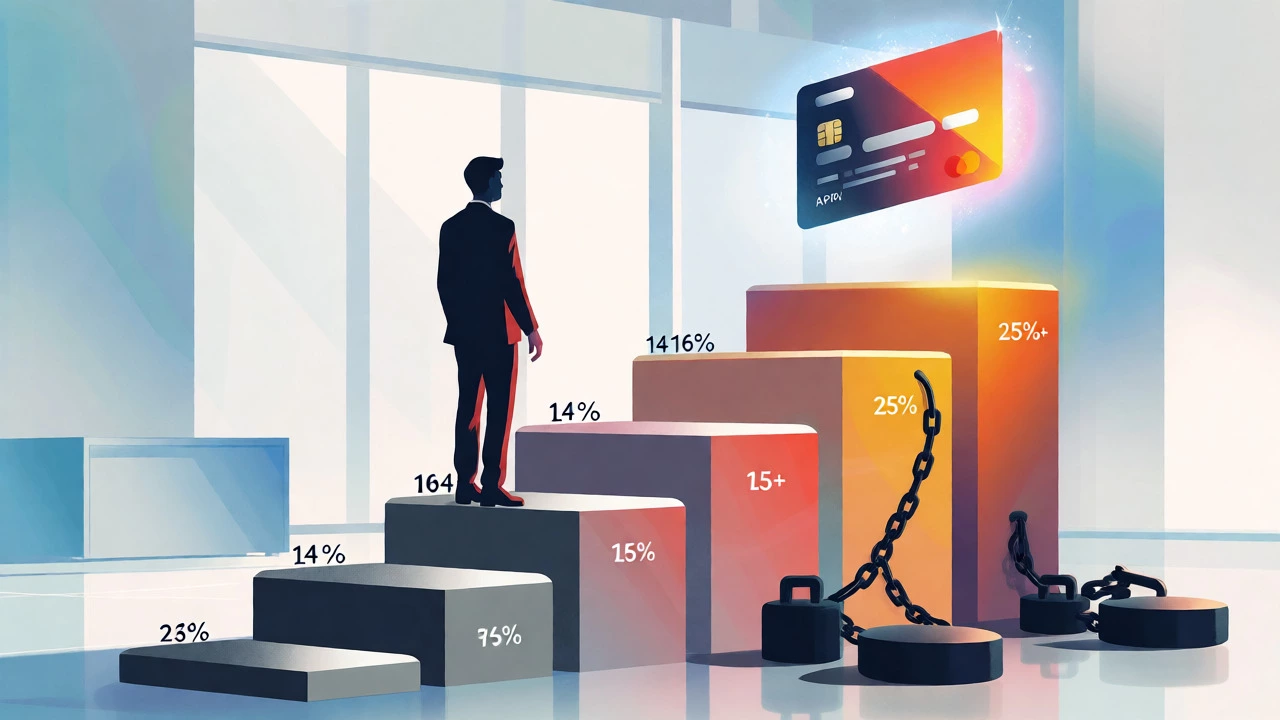
Banks don't guess; they calculate. Your credit score is the primary lever determining the APR you get approved for. Here is how the tiers generally look in the current market:
- Excellent Credit (780+): You qualify for the best available rates, often 14-16%. You also have leverage to negotiate or switch providers easily.
- Good Credit (700-779): Expect offers in the 17-20% range. This is still healthy territory if you manage your utilization ratio below 30%.
- Fair Credit (630-699): Rates jump to 21-25%. At this stage, focus shifts from finding the lowest rate to building credit history. Secured cards might be necessary.
- Poor Credit (<630): APRs often exceed 26-29%. Subprime lenders charge a premium for risk. Avoid carrying balances at all costs here.
Remember, pre-qualification tools let you see potential rates without a hard inquiry. Use them. Applying blindly can result in a rejected application and a temporary dip in your score, leaving you with worse terms if you apply again immediately.
| Credit Score Range | Estimated Purchase APR | Best Strategy |
|---|---|---|
| 780 - 850 (Excellent) | 14% - 16% | Negotiate lower rates; maximize rewards. |
| 700 - 779 (Good) | 17% - 20% | Utilize 0% intro offers for big purchases. |
| 630 - 699 (Fair) | 21% - 25% | Pay in full monthly; avoid cash advances. |
| < 630 (Poor) | 26% - 30%+ | Focus on repayment speed over rate reduction. |
Fixed vs. Variable APRs
Most modern credit cards use variable APRs. This means your rate is tied to a benchmark index, such as the Federal Reserve's prime rate in the US or the base cash rate in New Zealand. When central banks raise rates, your credit card APR goes up automatically, usually within one billing cycle. There is no warning letter saying, "Your rate is changing," because the contract already allows it.
Fixed APRs are rare in consumer credit cards today. They lock in your rate regardless of economic shifts. While stability sounds appealing, fixed rates often start higher than initial variable rates. Unless you anticipate massive inflation spikes, a variable rate with a solid repayment plan is usually the pragmatic choice. Always check the fine print for the margin added to the index (e.g., Prime + 12%).
Why a Low APR Isn't Always the Best Choice
Here is a controversial take: chasing the absolute lowest APR can lead you to bad financial products. Why? Because banks make money in two ways: interest and fees/rewards. A card with a 15% APR might have no rewards, no sign-up bonus, and high foreign transaction fees. A card with a 20% APR might offer 3% cash back on groceries and travel.
If you pay your balance in full every month, the APR is irrelevant. You should prioritize rewards, perks, and fee structures instead. You only need to obsess over APR if you habitually carry a balance. Ask yourself honestly: Do I pay my bill in full? If yes, ignore the APR column. If no, optimize for the lowest possible rate, even if it means giving up lounge access or airport credits.

Regional Differences: US vs. NZ Context
Since I'm writing from Auckland, it’s worth noting that terminology differs slightly. In New Zealand, we refer to this as the "Interest Rate" rather than APR, though the concept is identical. NZ credit card interest rates tend to be higher than average US rates due to different regulatory environments and bank margins. Typical NZ rates hover around 18-22% for standard cards. However, NZ banks often offer lower rates for customers who hold mortgages or savings accounts with them. Loyalty pays off here in a way it sometimes doesn't in the US market.
In the US, the Truth in Lending Act mandates clear APR disclosure. In NZ, the Credit Contracts and Consumer Finance Act (CCCFA) provides similar protections, requiring clear breakdowns of fees and interest calculations. Regardless of location, always read the Terms and Conditions regarding penalty APRs. Missing a payment by 60 days can trigger a punitive rate hike, often jumping to 29.99%, regardless of your previous agreement.
Actionable Steps to Secure a Better Rate
Don't just accept the first offer. Treat your credit card like a mortgage negotiation. Here is how to improve your position:
- Check your report first: Ensure there are no errors dragging your score down. Disputing a single error can boost your score enough to drop into a lower APR tier.
- Call and ask: If you've been a customer for over six months and haven't missed a payment, call your issuer. Say, "I've received an offer for a new card at 16%, but I'd prefer to stay with you. Can you match this rate?" Success rates vary, but it costs nothing to try.
- Consider a balance transfer: If you are stuck with a 24% APR, moving that debt to a card with a 0% intro APR for 15 months can save hundreds in interest, provided you pay off the principal during the promo period.
- Automate payments: Set up autopay for at least the minimum due. This prevents late fees and penalty APR triggers, keeping your rate stable.
Key Takeaways
- A good purchase APR in 2026 is under 20%; under 15% is excellent.
- APR matters only if you carry a balance. If you pay in full, focus on rewards.
- Balance transfer promos (0% intro) are often more valuable than a permanently low APR.
- Cash advance APRs are nearly always higher and lack grace periods.
- Your credit score directly dictates your rate; improving your score lowers your cost of borrowing.
Is a 20% APR good for a credit card?
A 20% APR is considered average to slightly above-average in the current market. It is acceptable for someone with good credit who occasionally carries a balance, but it is not ideal. Those with excellent credit should aim for rates closer to 14-16%. If you pay your balance in full every month, however, a 20% APR has zero impact on your wallet.
Does APR include fees?
Technically, Annual Percentage Rate includes the interest rate plus certain mandatory fees (like origination fees) spread over the loan term. However, in credit card contexts, APR usually refers strictly to the interest rate. Late fees, annual fees, and foreign transaction fees are typically excluded from the APR calculation but still affect your total cost of ownership. Always look at the "Total Cost" rather than just the APR.
Can I negotiate my credit card APR?
Yes, especially if you have a strong payment history and a good credit score. Calling your bank and mentioning competitor offers can sometimes result in a rate reduction. Banks prefer retaining existing customers over acquiring new ones, so they may offer a retention rate to keep you from switching. This works best with smaller regional banks or credit unions rather than large national chains.
What happens if I miss a payment?
Missing a payment can trigger a Penalty APR. This is a higher interest rate, often capped at 29.99%, that applies to your outstanding balance and potentially future purchases until you make consecutive on-time payments (usually six months). Additionally, you will incur a late fee, which can range from $25 to $40 depending on your region and card issuer.
Is a secured credit card APR higher?
Not necessarily. Secured cards are designed for building or rebuilding credit. Because the issuer holds a cash deposit as collateral, their risk is lower. Consequently, some secured cards offer competitive APRs comparable to unsecured cards for fair-credit users. However, many secured cards come with annual fees to offset the administrative cost, so compare the total cost, not just the APR.