

Student Aid Index (SAI) Estimator
Family Financial Data
Your Estimated Results
Enter your details to see how your financial profile translates into a Student Aid Index (SAI).
You’ve heard the rumors. Maybe a friend told you that if your parents make more than $60,000 a year, you’re out of luck when it comes to college money. Or perhaps you saw a social media post claiming there’s a hard cap on income for Pell Grants. The truth is messier, but also much better news: there is no official income limit for financial aid. You can earn millions and still qualify for some forms of assistance, just as you can earn very little and still face high costs due to other factors.
The confusion stems from how financial aid actually works. It isn’t a simple pass/fail test based on a paycheck. It’s a formula. That formula looks at your total financial picture, not just your gross income. While income is a huge piece of the puzzle, it’s only one variable among many. To understand what salary might be "too high," we need to look under the hood of the Free Application for Federal Student Aid (FAFSA) and the new Student Aid Index (SAI).
Before we get into the math, it helps to know where to find reliable data. If you are researching specific programs or need to verify details about aid eligibility in different contexts, checking official directories like this resource can sometimes provide structured lists, though for U.S. federal aid, the Department of Education remains the primary source. For now, let's stick to the mechanics of American higher education funding, which is where most of these questions originate.
The Death of the EFC and the Rise of SAI
If you did your research last year, you might have seen references to the Expected Family Contribution (EFC). As of the 2024-2025 award year, the EFC is gone. In its place is the Student Aid Index (SAI). This change was part of the FAFSA Simplification Act. The goal was to make the calculation easier to understand, but it has created new confusion.
The SAI tells colleges how much financial strength your family has to contribute toward one year of college costs. A lower SAI means you likely qualify for more aid. An SAI can even be negative-specifically, it can go down to -1,500. This doesn't mean the government owes you money; it simply signals that your family has zero ability to pay, maximizing your eligibility for need-based grants like the Pell Grant.
Here is the critical distinction: Your SAI is not the amount you will pay. It is a number used by colleges to determine your aid package. If a college costs $30,000 a year and your SAI is $5,000, the school *might* offer you $25,000 in aid. But if that same college costs $80,000, they might offer you $75,000. The SAI stays the same, but the aid changes based on the cost of attendance (COA).
Income Isn't Everything: The Asset Trap
This is where the "salary too high" myth gets debunked. Imagine two families. Family A earns $100,000 a year but owns their home outright, has no retirement savings because they spent it all on previous kids' weddings, and have significant medical debt. Family B earns $80,000 a year but has $200,000 in brokerage accounts and maxed-out 401(k)s.
Who qualifies for more aid? Often, Family A. Why? Because assets matter. Under the current rules, parental assets like savings accounts, stocks, and bonds are assessed at a rate of up to 5.64%. This means for every $100 in investable assets, the government assumes $5.64 is available for college. Income is protected to some degree through allowances, but assets are hit directly.
Furthermore, the value of your home is generally excluded from the calculation for most families. This is a massive benefit for middle-class homeowners. If you live in an expensive city like Auckland or San Francisco, your home equity might be substantial, but it won't tank your financial aid eligibility. However, if you own rental properties or second homes, those values *are* included in the asset calculation.
When Does Income Actually Matter?
So, when does a high salary hurt your chances? It hurts when combined with low expenses and high assets. The FAFSA formula calculates your "Adjusted Gross Income" (AGI) minus certain deductions. These deductions include taxes paid, the earned income tax credit, and a protection allowance based on family size.
Let’s look at a rough heuristic. For a typical family of four (parents plus two students), if your AGI is below $60,000, you are almost guaranteed to qualify for some form of need-based aid, provided you don't have excessive assets. As income rises above $100,000, the SAI starts to climb steadily. By the time you hit $200,000+, your SAI will likely be high enough that you won't qualify for federal grants like the Pell Grant or Supplemental Educational Opportunity Grant (SEOG).
However, "no grants" doesn't mean "no aid." Many private universities use their endowments to meet 100% of demonstrated financial need. They may offer large institutional grants to families earning $200,000+ if the cost of attendance is high. Conversely, a state university with a budget deficit might offer little to no aid to that same family, expecting them to pay the full sticker price.

The Role of Dependency Status
A crucial factor often overlooked is dependency status. If you are considered an independent student, your parents' income doesn't matter at all. You are evaluated based on your own income and assets. You are generally considered independent if:
- You are 24 years or older.
- You are married.
- You are working on a master's or doctoral degree.
- You are a veteran or active-duty member of the armed forces.
- You have dependents of your own (children or others who receive more than half their support from you).
If you fall into any of these categories, your parents' six-figure salary is irrelevant. The financial aid office will look at your tax returns. If you're a grad student with no income and a spouse with no income, you could qualify for maximum aid regardless of your parents' wealth. This is a common loophole for older students returning to school.
Pell Grants and the Hard Caps
While there is no universal income limit, there are specific thresholds for specific programs. The Pell Grant is the most generous federal grant, offering up to $7,395 for the 2024-2025 academic year (adjusted annually for inflation). To qualify for the maximum Pell Grant, your SAI must be -1,500 to $0. This typically corresponds to families with very low incomes and few assets.
As your SAI increases, your Pell Grant amount decreases. Generally, if your SAI is above $7,000-$8,000, you will likely not qualify for any Pell Grant funds. This usually aligns with an AGI of roughly $60,000 to $70,000 for a family of four, depending on deductions. So, if your goal is specifically to get a Pell Grant, then yes, a salary over $70,000 is probably "too high." But again, this is just one type of aid.
Strategic Planning for High-Income Families
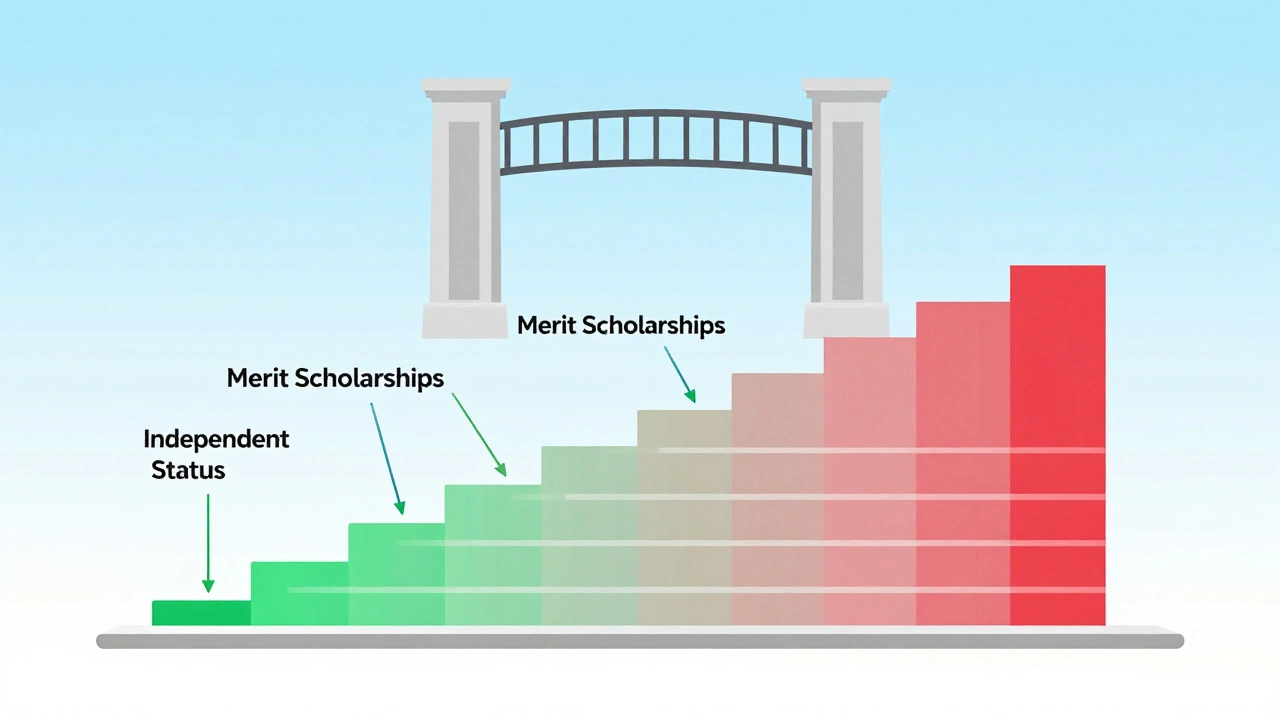
If you suspect your income might push you out of the need-based aid bracket, don't panic. There are other avenues. Merit-based scholarships are awarded based on academic achievement, athletic ability, or artistic talent, regardless of income. Many private colleges offer merit scholarships to attract top students, even those from wealthy backgrounds.
Additionally, consider the net price calculator. Every accredited college in the U.S. is required to have one on their website. Enter your real financial data-don't guess-and see what the school estimates you'll pay. This tool uses the same algorithm as the FAFSA. If the calculator shows a low net price, you'll likely get good aid. If it shows the full tuition, you'll likely pay close to that amount.
Another strategy is to maximize contributions to 529 plans carefully. While 529 plans owned by parents are assessed at a favorable rate (up to 5.64%), 529 plans owned by grandparents or other relatives are treated differently. Grandparent-owned 529 distributions can count as untaxed income for the student, potentially reducing aid eligibility in the year of distribution. Timing matters here.
Common Mistakes to Avoid
Many families make errors that inflate their SAI unnecessarily. One common mistake is failing to report all sources of income. The FAFSA asks for prior-prior year tax data. If you had a windfall-like selling a car or receiving a bonus-make sure it's reflected correctly. Another error is ignoring the special circumstances appeal. If your family experienced a job loss, divorce, or major medical expense after filing taxes, you can contact the financial aid office directly. They have the discretion to adjust your SAI manually based on current hardships.
Also, beware of "independent student" scams. Some services claim they can help you fake independence status. This is fraud. The consequences include losing all federal aid, having to repay loans immediately, and potential legal issues. Stick to the legitimate criteria listed above.
Is there an income limit for federal student loans?
No. Direct Subsidized and Unsubsidized Loans are available to eligible students regardless of family income. However, the amount you can borrow is limited by your year in school and dependency status, not your salary. Interest rates are set by Congress and are fixed for the life of the loan.
Does my parents' home equity affect financial aid?
For most families, the equity in your primary residence is excluded from the FAFSA calculation. This means the value of your home does not increase your Student Aid Index (SAI). However, if you own additional properties like vacation homes or rental units, those values are included as assets.
What is the maximum Pell Grant for 2025?
The maximum Pell Grant amount fluctuates slightly each year based on inflation adjustments. For the 2024-2025 award year, the maximum was $7,395. Students with a Student Aid Index (SAI) between -1,500 and $0 are typically eligible for the maximum award.
Can I get financial aid if my parents make $200,000?
Yes, but it depends on the college. You likely won't qualify for federal need-based grants like the Pell Grant. However, many private universities offer institutional grants based on their own formulas. Additionally, you may qualify for merit-based scholarships and federal student loans.
How do assets affect my financial aid eligibility?
Parental assets such as savings, stocks, and bonds are assessed at a rate of up to 5.64%. This means for every $100 in assets, the government assumes $5.64 is available for college costs. Student assets are assessed at a higher rate of 20%, so it is often better for parents to hold investments rather than the student.